

From the Power Plant To Your Phone
How to trade the world’s biggest bottleneck.

For more valuable knowledge about Solar Energy, here is my previous article about it :

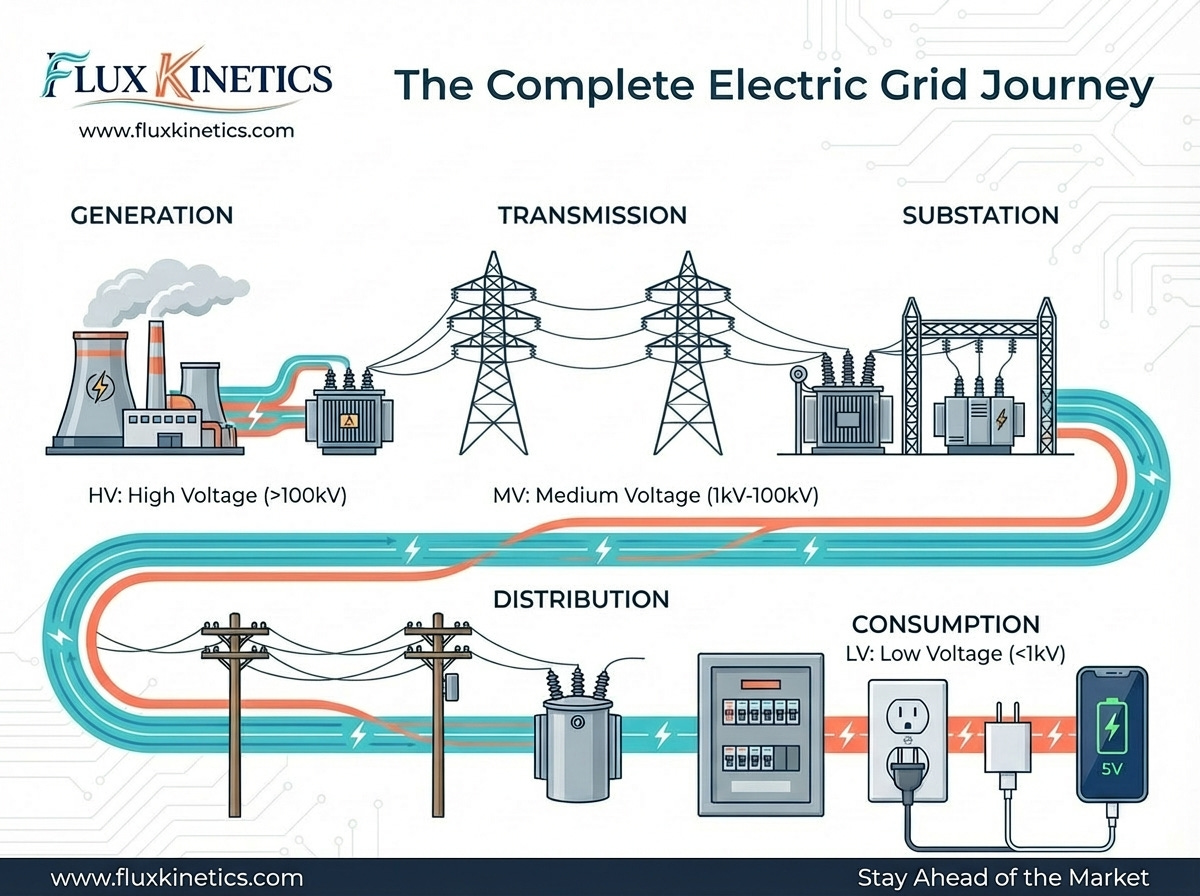
Every time you plug in your phone, a global industrial system that cost tens of trillions of dollars wakes up on your behalf. It stretches from gas fields, dams, reactors, solar farms and wind fleets to copper mines, transformer factories, chip plants, and finally the lithium in your battery.
Most people never think about it. Investors and policymakers cannot afford that luxury.
THE BREAKDOWN:
The Physics: How high power drops to low power. Why this drives the need for more metals.
The Tech: The hidden fight inside your phone charger. New chips versus old chips.
The Supply Chain: The big shortage of power parts. Who controls the battery metals.
The Law: Why local rules control the grid. How slow permits block new profits.
The Playbook: Four easy steps to trade this trend. How to make money from power limits.
1. Generation: Where Electrons Begin
The story starts at the power plant, but the real inputs are fuel, water flows, sunlight, and wind.
Thermal plants burn coal or gas to boil water, spin a steam turbine, and drive a generator. A gas plant can turn fuel into electricity in under ten minutes, which is why grid operators lean on it for flexibility and peaking capacity. Nuclear plants do the same turbine trick with a reactor core instead of a burner, trading flexibility for very high capacity factors and fuel that fits in a building for years at a time.
Hydro uses gravity, not combustion. Water falling through a dam spins a turbine directly. Costs are front loaded into concrete, steel, and transmission. Once built, the marginal “fuel” cost is close to zero. Solar and wind skip the steam stage entirely. Solar panels turn photons into DC electricity through semiconductor junctions. Wind turbines convert rotation in the nacelle into AC power that is synchronized to the grid.
From an investment angle, generation is where policy and fuel price risk live. Gas and coal plants are tied to commodity curves and carbon policy. Nuclear depends on long-lived regulatory regimes and uranium supply chains, especially enrichment. Solar and wind ride learning curves in modules, inverters, and blades, plus land and interconnection bottlenecks.
The key point, though, is that at the generator terminals you already see the first materials story. Copper and electrical steel in the generator. Rare gases and high purity silicon in solar cells. High strength fiber glass and resins in blades. That physicality matters once you care about bottlenecks.
2.Transmission: High Voltage, High Stakes
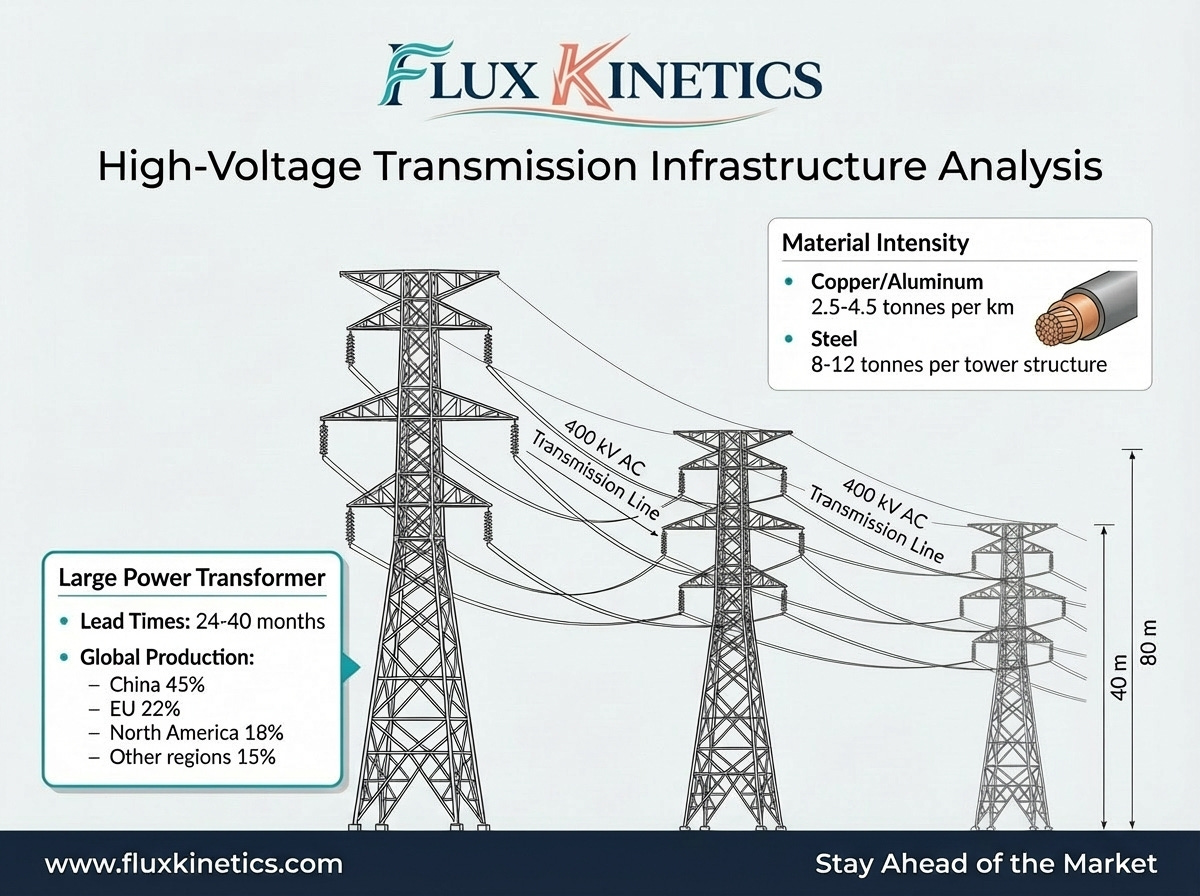
Right out of the plant, voltage is stepped up from tens of kilovolts to the hundreds, usually 230 to 500 kilovolts, sometimes higher. That step-up transformer is a large, oil-filled, copper and steel box the size of a small house. It is also one of the most stressed parts of the grid supply chain today, with global lead times stretching into years in some markets.
At high voltage, current drops, which cuts resistive losses and makes long-distance transport economical. Typical transmission losses are on the order of 2 to 4 % per hundred km, adding up to roughly 5 to 10% from plant to consumer in many systems. Overhead lines use aluminium conductors reinforced with steel, slung from steel towers sunk into concrete. Underground or subsea high-voltage cables add insulation, sheathing, and much more cost.
Transmission is where copper, aluminium, and steel volumes really add up. A single large line can carry thousands of amperes over hundreds of km, and each km of conductor contains tens to hundreds of kilograms of metal. Grid expansion plans in the United States, Europe, China, and India imply multi-decade structural demand for these metals, even in efficiency scenarios.
For investors and policymakers, the chokepoints are clear. Limited rights of way and local opposition slow new lines. Large power transformer manufacturing is concentrated in a small set of firms and regions. Extreme weather and cyber risk both hit long-distance networks hard. Geopolitically, cross-border interconnector can be a source of resilience, or a pressure point, depending on who controls the switches.
3. Distribution: The Last Ten Miles
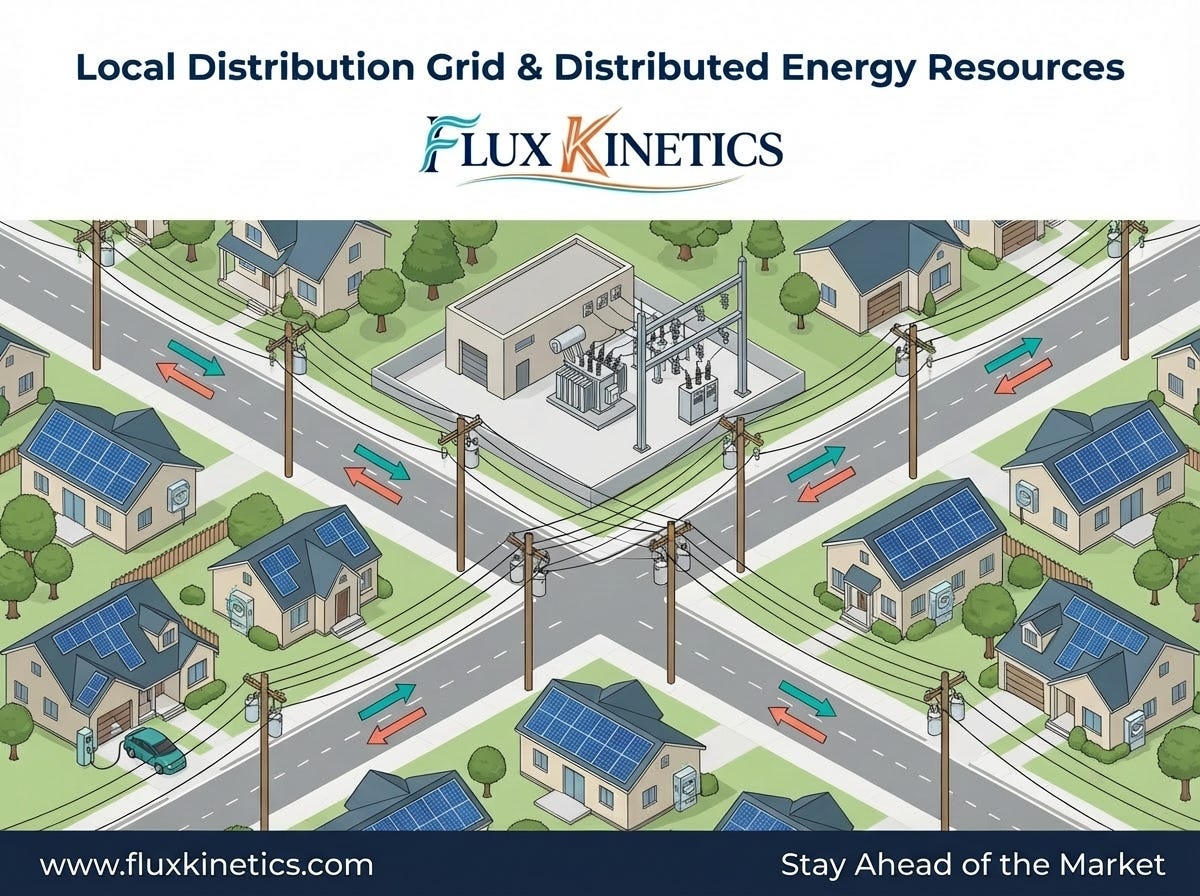
From the bulk grid, voltage is stepped down at a substation. Think fenced yards filled with transformers, breakers, and switchgear that drop high voltage to medium levels suitable for cities and large customers. From there, distribution feeders radiate out along streets, under sidewalks, and through industrial parks.
At the edge of the network, a pole-top or pad-mounted transformer takes medium voltage, often in the 10 to 33 kilovolt range, down to the 230 or 120 volts serving homes and small businesses. Each of those transformers is another cylinder of copper windings, grain-oriented electrical steel, and insulating oil, plus bushings and bush bars. A single neighbourhood may rely on only a handful of them. Lose one without a spare and dozens of buildings go dark.
This is also where automation and data start to matter. Smart meters, remote-controlled switches, and sensors on lines feed status back to control rooms and algorithms. That cuts outage times and helps integrate rooftop solar, electric vehicle charging, and behind-the-meter batteries. On the materials side, the distribution grid is a huge, slow-moving consumer of copper, aluminium, porcelain, polymers, and increasingly silicon chips.
Right now, many developed grids are old. Large parts of North American and European distribution networks date back to the mid twentieth century. Regulators are pushing utilities to modernise, often allowing them to earn returns on grid investments that can rival generation projects, but with very different risk and regulatory profiles. Transformer shortages, labor constraints, and permitting delays all sit squarely in this stage of the chain.
4. Inside The Wall And Into Your Phone
Once electricity reaches your building, it passes through a main panel with breakers sized to protect wiring and equipment. Copper conductors behind the walls carry low-voltage AC to outlets and lighting circuits. In commercial buildings and data centers, this last leg includes busbars, switchgear, and sometimes on-site backup generators and batteries as well.
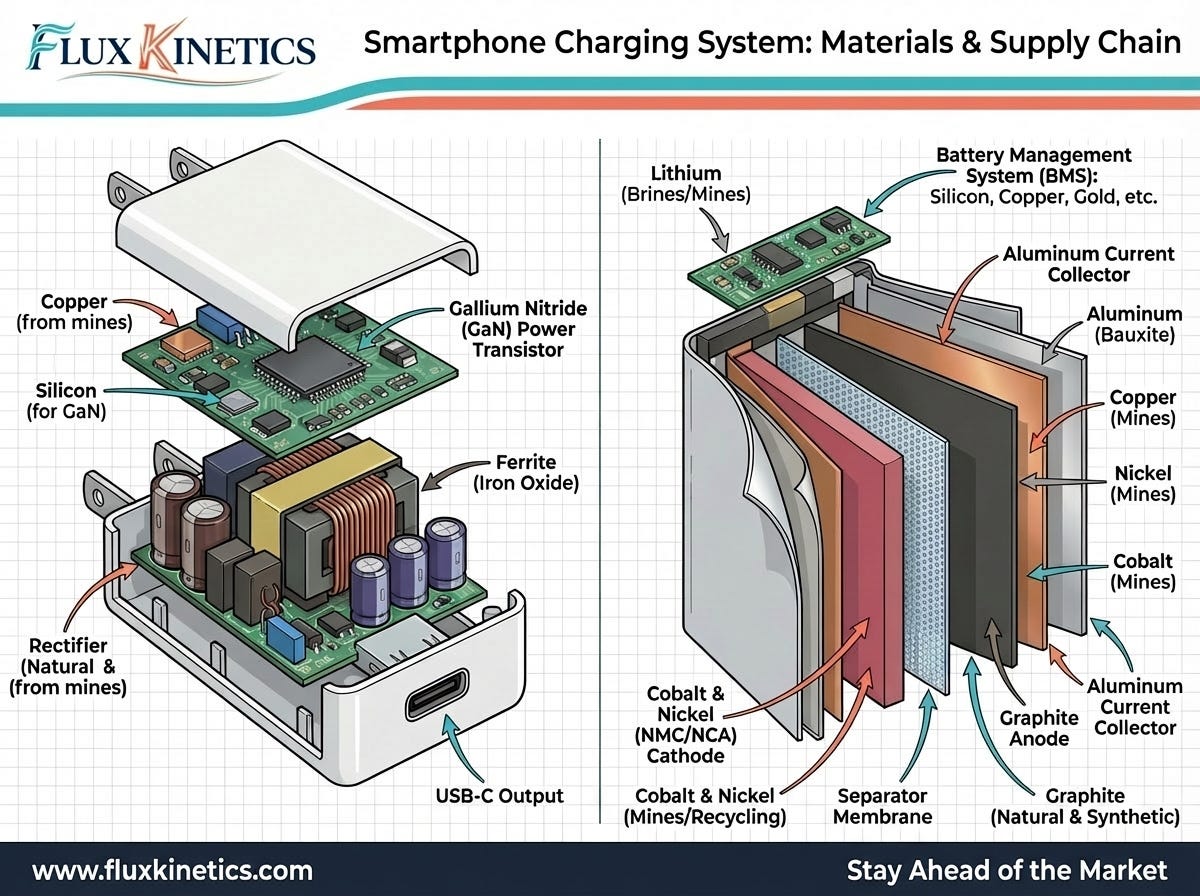
Your charger is a miniature power plant in reverse. It takes AC from the wall and converts it to low-voltage DC, typically 5 to 20 volts for phones and laptops. Inside are tiny transformers, capacitors, diodes, and a switching chip that turns the flow on and off thousands of times per second to control voltage and current. This is where gallium nitride and advanced silicon power devices compete for efficiency and size.
Finally, the battery in your phone stores energy electrochemically. Most modern devices use lithium-ion chemistries that rely on lithium in the electrolyte, cobalt, nickel, manganese or iron in the cathode, graphite in the anode, and copper and aluminium foils as current collectors. Those materials come from globally concentrated supply chains, with mining and refining often clustered in a few countries and cell manufacturing dominated by East Asian firms.
From a systems view, that 20 watt-hour phone charge ties together upstream fuel markets, grid hardware, copper and aluminium, power electronics, and battery metals. When any part of that chain tightens, it shows up as higher tariffs, slower grid connections, pricier hardware, or more fragile supply security.
Why This Journey Matters For You
If you work in markets or policy, this is not just engineering trivia. It is a live risk map and opportunity set.
Generation tells you where exposure to fuel price, carbon policy, and technology learning curves sits. Transmission and distribution show where capex is locked in, heavily regulated, and slow to change, but also where regulated asset bases and allowed returns can create durable earnings streams. Devices and batteries reveal where high-margin components, intellectual property, and commodity sensitivity intertwine.
For energy security and resilience, weak points include large power transformers with long replacement times, aging distribution equipment, and concentrated mining and refining of copper, lithium, cobalt, and nickel. For investors, the same list doubles as a menu of structural demand stories in metals, grid equipment, and power electronics.
If you want more pieces like this that translate physical infrastructure into tradable themes and policy decisions, hit subscribe so you do not miss the next one.
If someone on your desk or in your policy team thinks of electricity as a black box, send this to them.
A Done-For-You Grid Exposure Plan
Here is a simple four step framework you can run through in an hour to map your own exposure along this chain.
1. Map where your capital and attention sit today. List current investments or policy focus areas across four buckets: generation, transmission, distribution, and devices or storage. Note where you are concentrated.
2. Identify the hardware chokepoints that matter most to you. For each bucket, write down the critical hardware that fails slowly to scale. That might be gas turbines and fuel supply, large power transformers, distribution automation gear, or battery cells and chargers.
3. Trace back the materials behind that hardware. Connect each chokepoint to its main materials or components. Examples include copper and electrical steel in transformers and lines, semiconductors in inverters and chargers, and lithium, nickel, cobalt, and graphite in batteries.
4. Link those materials to suppliers, jurisdictions, and policy risk. Ask where the key mines, refiners, and factories sit on a map, who controls them, and how exposed they are to trade tensions, export controls, or local politics. Then compare that map to your portfolio or policy toolkit.
If you repeat this exercise once or twice a year, you will start to see the grid not as a tangle of wires, but as a structured set of exposures that you can hedge, invest in, or regulate with intent.
If you found this helpful, consider subscribing to Flux Kinetics and forwarding it to a friend or a colleague who cares about how electrons, metals, and policy intersect.
Share this post and bring them into the conversation. That is who Flux Kinetics is written for.
Flux Kinetics - Where energy meets intelligence,
Wassim C.

This content is for educational purposes only and does not constitute financial, legal, or tax advice. All opinions and analyses are my own, and any actions you take are at your own risk after consulting an appropriate professional.
Thank you for breaking down this process, it’s more easy to understand with such clear explanation :)
Nice tour to understand what happens, instead of thinking you plug in your phone and it just works. And a good takeaway on the bottlenecks, especially given how AI is so energy-hungry.
I've been hearing more and more about copper. Might have to research further and find plays.