

Your CEO Just Killed Your $4 Billion Project
The 47-day approval that cost more than the decision itself.


There’s a number that should terrify anyone running energy mega projects: average decision latency for approvals over $10 million now exceeds 47 days. That’s six weeks where engineers wait, contractors burn rate, and concrete literally hardens while your competition moves.
I’ve watched this kill LNG terminals in Angola and refinery expansions in Texas. The pattern never changes. A project manager needs approval to relocate a compressor station 200 meters due to unstable geology. Engineering, procurement, construction, HSE, and the CEO all must sign off. By the time approval lands, the weather window closed, the crane is booked elsewhere, and you just burned $3 million on standby costs.
The counter intuitive truth? Leaders who move fastest aren’t making only faster decisions. They’ve engineered decision-making out of the critical path entirely.
What you’ll learn in the next 5 minutes:
The Decision Rights Matrix that keeps Shell’s $6B projects moving.
Why the “5-hour rule” separates successful mega projects from failures.
How CEO micromanagement creates the approval death spiral.
The Flux Protocol: your 4-week implementation plan to cut decision latency by 40%.
A. The Framework Nobody Uses
Walk into Shell’s project control room for their $6 billion Pennsylvania Chemicals complex, which somehow delivered 9,000 workers on schedule. You won’t find the CEO approving valve specifications.
What you will find: a ruthlessly clear Decision Rights Matrix.
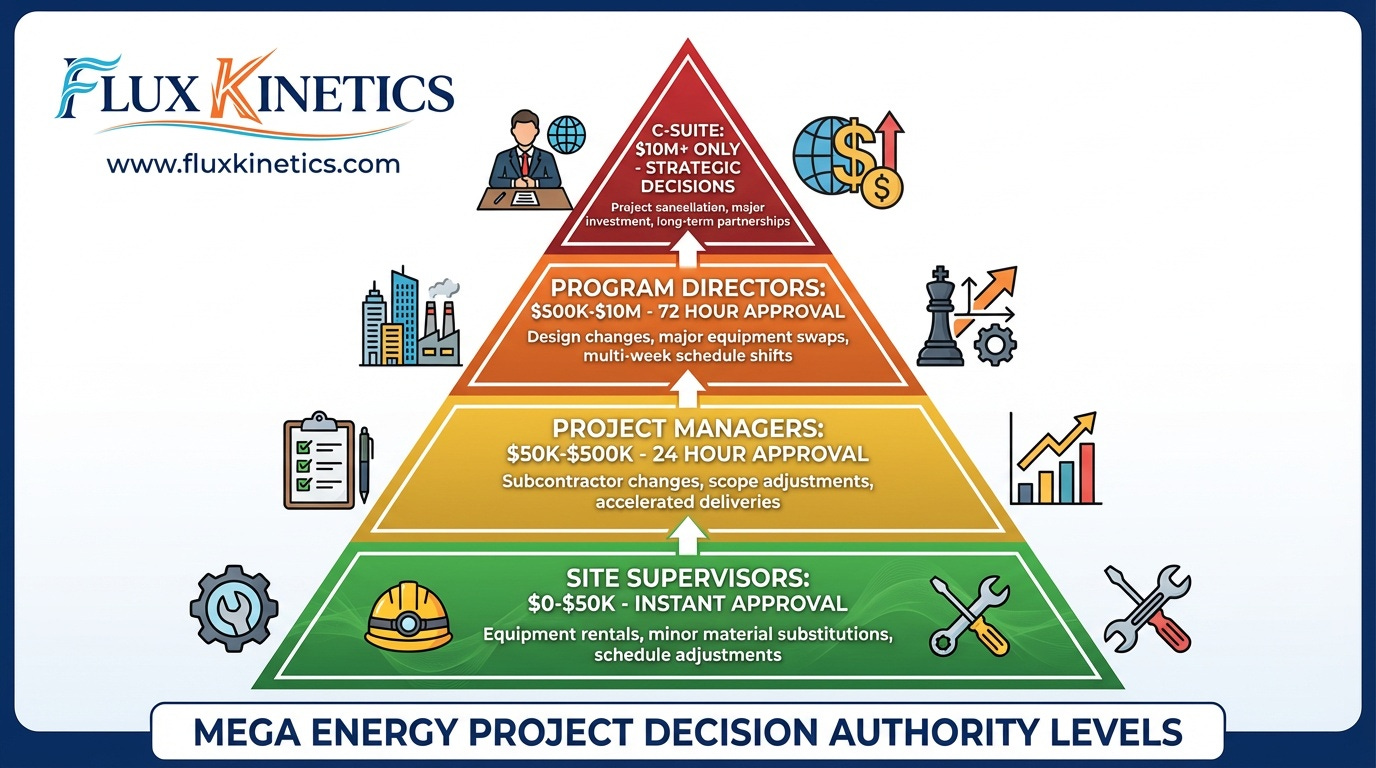
Site supervisors green-light up to $50,000 without a single email to headquarters. That covers 80% of daily decisions clogging executive calendars. Backup generator rental because primary failed? Done in an hour, not a week.
Project managers hold authority to $500,000. That eliminates the absurd situation where a $4 billion project halts waiting for someone to approve a $200,000 concrete pour.
Only decisions exceeding $10 million, or fundamentally altering project scope, escalate to C-suite review.
B. The Five-Hour Death Zone
Independent Project Analysis evaluated over $2 trillion in capital projects. Projects missing budget or schedule by 25%+ shared one trait: decision latency exceeding five hours for operational issues.
Five hours. That’s where delays cascade into disasters.
A fabrication yard discovers the specified steel grade exceeds what’s needed. Using the correct grade saves $400,000 and six tons of weight. In decision paralyzed organizations, this triggers engineering validation, procurement verification, budget updates, risk assessment, and legal review. Four weeks later, approval arrives. The fabricator moved on. Re-mobilization costs $180,000. You converted a $400,000 opportunity into a net loss plus four weeks of delay.
In decision competent organizations, the site engineer has delegated authority up to $500,000 for technical substitutions maintaining specifications. Approval happens in 90 minutes. Savings materialize. Project stays on track.
Company D, a Canadian oil sands operator, faced a 65-day shutdown window to relocate mine trains. Missing the deadline meant millions daily in lost production. Their approach: every crew received pre-approved decision authority for any issue under $100,000 not affecting safety or environmental compliance.
Result? Fifteen percent under budget. Zero missed milestones. In an industry where 65% of mega projects fail objectives and 50% cost overruns are normal, finishing 15% under budget is statisticaly impossible.
C. The CEO Approval Trap
If your CEO must sign off on concrete pours, what exactly are you paying your project manager to do?
Edward Merrow’s research on megaproject failures identified “leadership-driven bottlenecks” as a primary failure mode. Not inadequate leadership. Excessive leadership involvement.
When executives insert themselves into operational decisions, pathologies emerge:
Information lag kills context. The CEO receives a two-page memo. The site engineer knows the supplier delivered substandard materials twice before, the backup option costs 20% more but works, and weather models show a three-day window closing tomorrow. Guess who makes the better call?
Risk calculus inverts. Executives think enterprise risk and board liability. Site leaders think about crews in 40°C heat needing that decision today. Both matter, but only one should drive operational choices within established parameters.
The organization learns helplessness. When every decision requires executive approval, your $180,000-per-year project managers become email forwarders, not leaders.
Darren Woods recently explained why ExxonMobil found Venezuela “uninvestable” despite the world’s largest oil reserves. Not geology. Governance. “Commercial frameworks” requiring PDVSA government approval for operational decisions that should rest with technical experts.
When politicians approve your valve supplier, your project is dead. When your CEO approves your concrete supplier, you’re running a slower version of the same dysfunction.
D. Decision Architecture That Scales
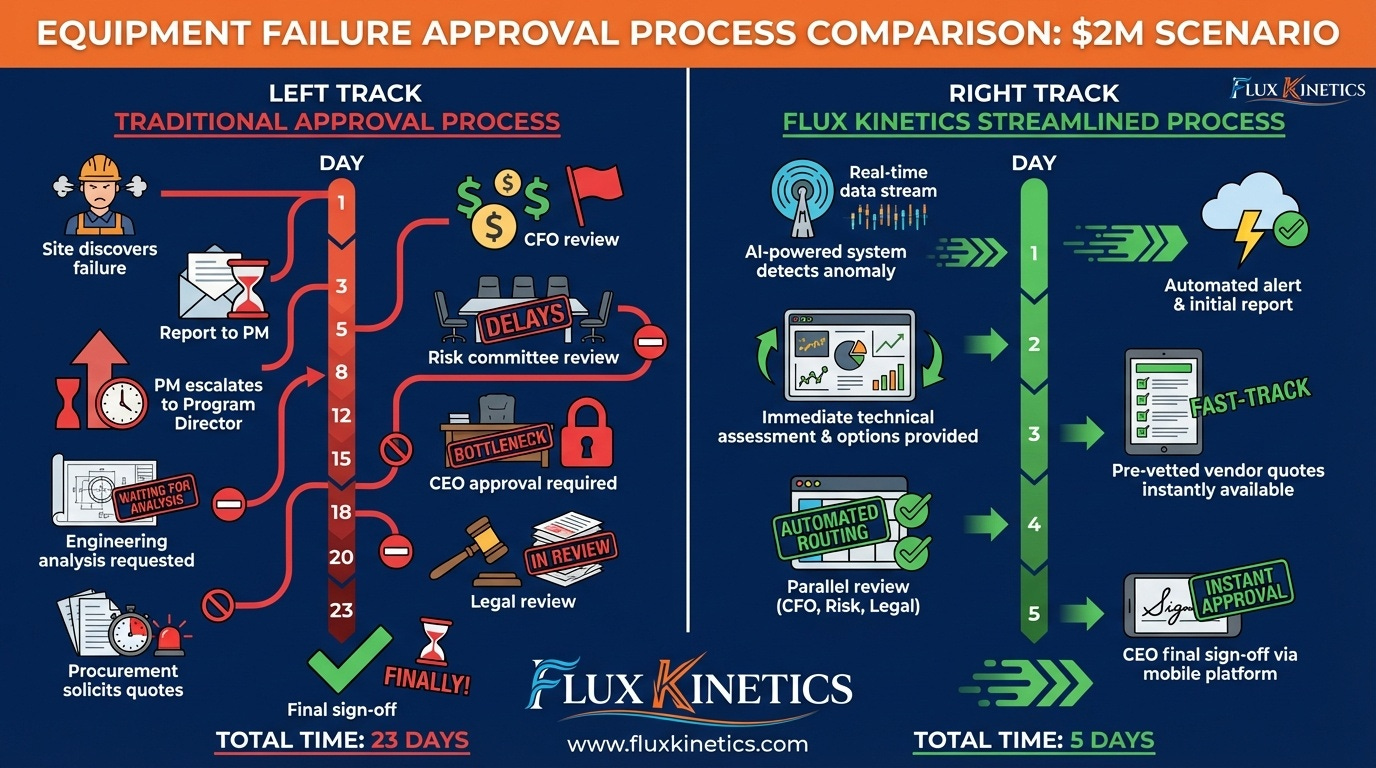
Sophisticated operators don’t gamble on heroics. They architect systems making right decisions fast and inevitable.
Map Your Decision Landscape: Audit your last 100 escalated decisions. Categorize by dollar value, speed, and impact. You’ll find 70-80% involved amounts below $250,000 and required executive time for choices project managers could make using clear criteria. Build your authority matrix on this data, not arbitrary thresholds.
Define Constraint-Free Standards: Advanced Work Packaging’s most powerful rule: don’t issue work unless constraint-free. Every drawing approved, materials on-site, permits secured. Apply this to decisions. Define what “constraint-free” means at each authority level. Decisions meeting criteria get approved immediately. Everything else escalates, but you’ve filtered 85% of noise.
Implement Decision Reviews, Not Approvals: Replace approval gates with review cycles. Leaders don’t approve before decisions happen. They review after, in structured sessions focused on learning. Chevron’s Permian operations use this. Project managers make hundreds of daily calls within authority bands. Weekly reviews examine samples, particularly near thresholds or novel situations. Focus isn’t “should we have approved?” but “what did we learn?” This maintains oversight, builds capability, and eliminates bottlenecks.
E. The Flux Protocol: Four Weeks to Fast Decisions
Week 1: Authority Audit
Pull your last project’s change orders and approval records. Track decision type, dollar value, approver, delay time, and actual impact. Sort by approval delay. Hunt for decisions costing more in delay than they saved in risk mitigation. That’s your target.
Week 2: The $100K Experiment
Give three trusted project managers explicit authority to approve anything up to $100,000 meeting clear criteria: maintains safety, uses pre-qualified vendors, doesn’t alter critical path beyond 72 hours, stays within scope intent. Track every decision for two weeks. You’ll see zero consequential errors and 40% reduced decision latency.
Week 3: Draft Your Matrix
Based on audit and experiment, draft authority levels: Site supervisors $0-50K, Project managers $50K-500K, Program directors $500K-10M, C-suite $10M+ or strategic changes. You’ll get pushback from executives enjoying involvement. Remind them their time has opportunity cost, and approving concrete suppliers isn’t it.
Week 4: Rollout with Reviews
Implement on one pilot project. Institute weekly decision review sessions examining delegated decision samples. Don’t second-guess unless spotting competence gaps. After four weeks, expand to all projects. The data makes the case itself.
F. The Brutal Math
The energy transition requires $4 trillion in new infrastructure by 2030. LNG terminals, hydrogen facilities, carbon capture, refinery conversions, grid-scale batteries. All complex megaprojects under compressed timelines with zero margin for error.
Companies delivering these profitably won’t have the smartest CEOs. They’ll have CEOs smart enough to stay out of decisions they shouldn’t make.
Control is illusion. Real leadership builds systems making good decisions inevitable, fast, and scalable, then trusts those systems to work.
Your next mega project starts with a choice. Will you architect decisions at the speed of reality? Or build another monument to the CEO approval trap?

The clock is running. Your competitors are deciding. What’s your move?
If this just saved you 47 days: Comment which delegation threshold feels most uncomfortable (that’s the one costing you most), and share this with a project director drowning in approvals.
Want intelligence before headlines catch up? Subscribe to Flux Kinetics for weekly breakdowns keeping energy professionals ahead of the market.
Flux Kinetics - Where energy meets intelligence,
Wassim C.

This content is for educational purposes only and does not constitute financial, legal, or tax advice. All opinions and analyses are my own, and any actions you take are at your own risk after consulting an appropriate professional.
Great idea to audit past approval decisions to find efficiencies and clarify roles/approval process. A penny saved is still only a penny. Delegate decisions others can make to elevate focus!