

What Happens if Oil Stops Tomorrow?
The world burns 101.8 million barrels a day.

From your morning coffee to your kid’s insulin, petroleum runs deeper than anyone admits
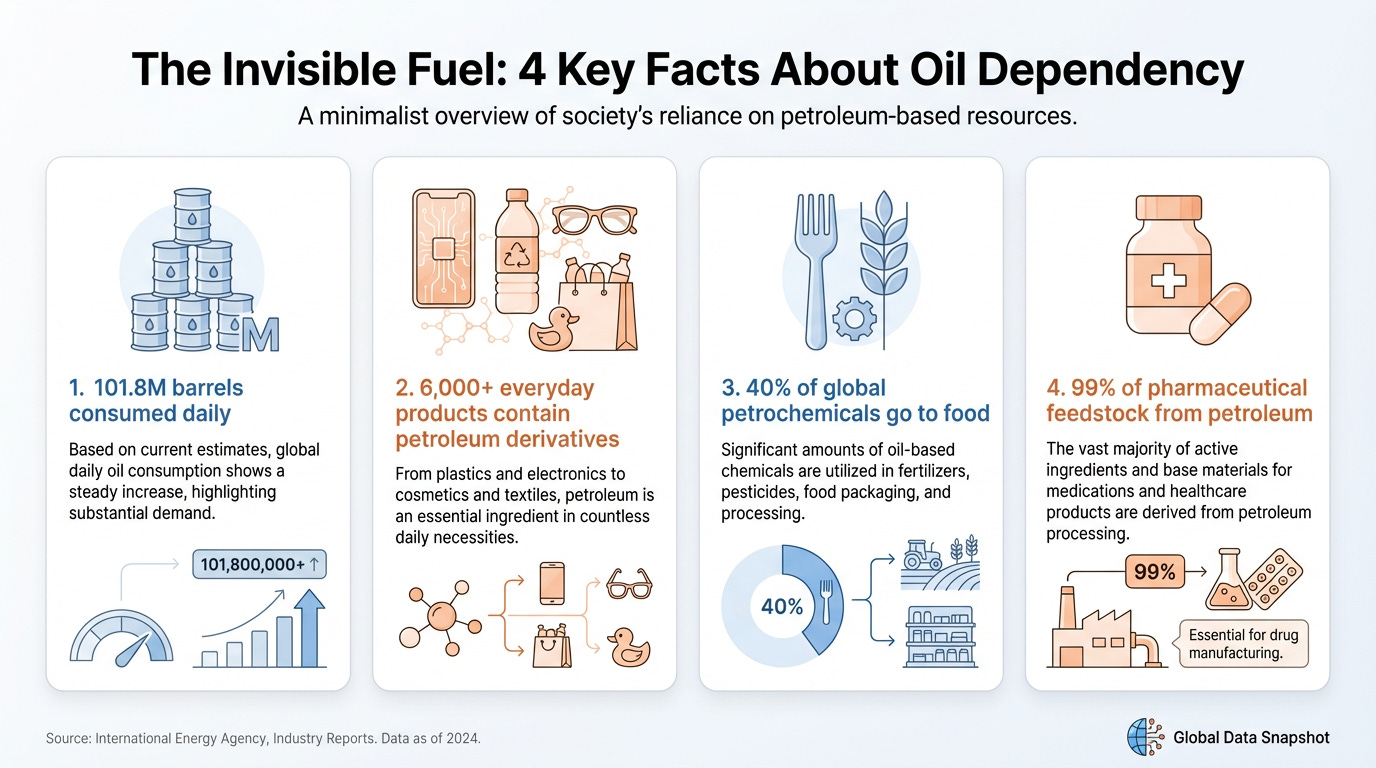
Global oil consumption hit 101.8 million bbl/d in 2024. Over 6,000 everyday products contain petroleum derivatives. The industrial food system burns through 40% of global petrochemicals. Pharmaceutical feedstock is 99% petroleum-based.
What did you touch in the first five minutes after your alarm went off?
Your phone screen. The polyester sheets you kicked off. The plastic toothbrush handle. Contact lenses in their case. A prescription bottle on the nightstand. Carpet fibers under your feet. The nylon jacket you pulled on before stumbling to the kitchen.
Every single one exists because of oil.
Not the gasoline in your tank, though global demand hit an all-time high of 101.8 million barrels per day in 2024, per IE data. I’m talking about petroleum derivatives so embedded in modern life that they’re invisible. That aspirin you dry-swallowed? Petroleum-based benzene. Your shampoo? Loaded with petroleum derivatives. The bright red in your daughter’s favorite shirt? Petroleum-derived dye.
This isn’t a guilt trip about carbon footprints. It’s a harder question that nobody asks out loud.
What actually happens if oil production stops tomorrow? Not in 2075 when we’ve got alternatives scaled up. Tomorrow morning. When you wake up and every wellhead, refinery, and pipeline on earth has gone silent.
The answer has nothing to do with gas prices.
The Stuff Nobody Sees
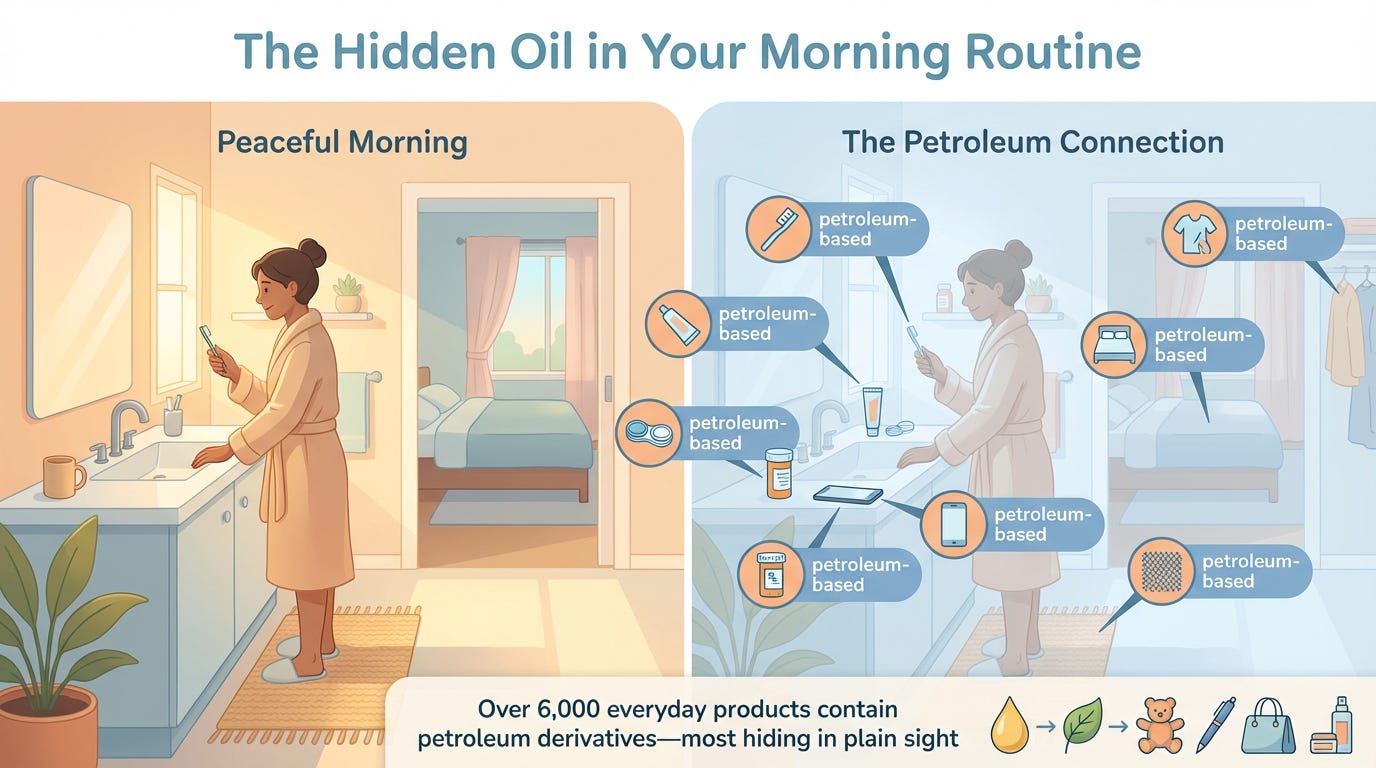
Over 6,000 everyday products contain petroleum derivatives. Most hide in plain sight. Your toothbrush. Your phone. The carpet. The prescription bottle. All petroleum-based materials that disappear into the background of daily life.
Walk through your house right now. Really look.
That couch you’re sitting on? Polyurethane foam cushions. Petroleum. The paint, the insulation, the laminate flooring. All petroleum products. Open your medicine cabinet. Most pharmaceuticals contain petrochemical ingredients. Aspirin, Novocaine, antibiotics, chemotherapy drugs.
For parents, the dependency gets worse. Baby bottles, pacifiers, disposable diapers, car seats, strollers, teething toys. That plastic baby monitor? Petroleum. The waterproof crib pad? Petroleum derivatives. Many baby wipes contain petroleum-based compounds.
“Petroleum-derived compounds are essential ingredients in medications, including antibiotics, pain relievers and anesthetics,” according to recent healthcare industry analysis. Medical devices depend entirely on processed plastics. Gloves. Syringes. IV bags. Tubing. Surgical equipment. Modern healthcare stops functioning without petroleum.
This isn’t politics. It’s infrastructure reality.
Over the past century, petroleum became the foundation of modern comfort, health, and safety in ways that extend miles beyond transportation fuel. So what happens when that foundation vanishes?
Day One: Grocery Stores Start Emptying
Tomorrow morning, every oil well shuts down. Every refinery goes cold. Every pipeline stops moving product. The gas in your tank still works. You’ve got one tank. Diesel trucks can make one more delivery run. Maybe two.
Then nothing.
Within 24 hours, you’d see the first crack. Grocery store shelves thinning out.
Transportation is the obvious problem. But the modern food system is what researchers call “fossil-fueled food.” The numbers are brutal. The industrial food system burns through 40% of all petrochemicals. It accounts for at least 15% of all fossil fuels consumed globally, per food systems research.
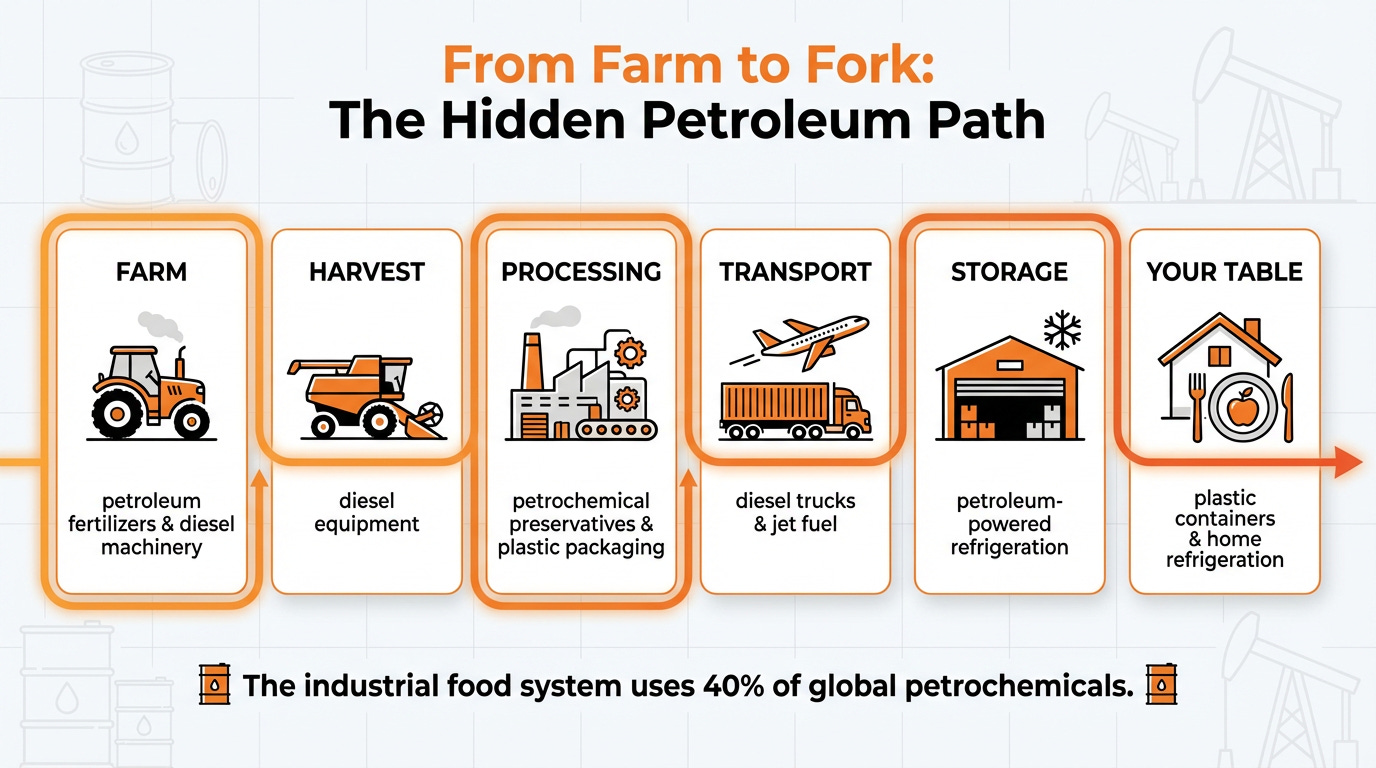
Your food moves through six petroleum-dependent stages before hitting your table. The industrial food system uses 40% of global petrochemicals. Fertilizers. Diesel machinery. Plastic packaging. Refrigerated transport. All petroleum.
Most people don’t realize it’s not just the truck. It’s the petroleum-based fertilizers that grew those tomatoes. The diesel that powered the harvesting equipment. The plastic packaging that protected them. The refrigeration systems keeping them fresh, powered by electricity generated largely from fossil fuels. The entire supply chain from seed to table depends on petroleum at virtually every step.
For parents feeding families, the math gets personal fast. That organic milk you picked out carefully? It traveled 1,500 miles to reach you, refrigerated the entire way. The fresh produce you’re teaching your kids to eat? Grown with petroleum-based fertilizers and pesticides, then transported long distances. Even the plastic bags, containers, and wrap that make modern food storage possible would disappear.
Three days. That’s how long fresh food supplies last in most urban areas. Within a week, the question isn’t organic versus conventional. The question is what’s available at all.
Week One: The Medicine Problem
Here’s where immediate cessation gets genuinely frightening. Especially for parents with kids on chronic medications. Anyone managing health conditions.
Modern medicine doesn’t just use petroleum for transport or packaging. Petroleum derivatives are intrinsic to healthcare itself. Petrochemicals provide the foundation for roughly 99% of pharmaceutical feedstock. Those nitrogen mustards in certain chemo treatments? Petroleum-based. The carboxylic acids used to make Novocaine, acetaminophen, sedatives, antibiotics? Derived from petrochemicals.
No petroleum means no insulin production. No asthma inhalers. No antibiotic manufacturing. Even basic OTC pain relievers disappear from pharmacy shelves within weeks as existing inventory runs out.
For parents, the scenarios get dark. A child’s EpiPen for severe allergies? The epinephrine inside and the plastic delivery mechanism both require petroleum. ADHD meds, diabetes management, seizure control. The list of petroleum-dependent treatments keeping kids healthy is long.
It’s not just medications. Medical devices depend critically on processed plastics derived from oil. Disposable gloves. Sterile syringes. IV bags and tubing. Blood collection bags. Dialysis equipment. Prosthetic limbs. Heart valves. Modern surgery, as we practice it today, becomes impossible without petroleum-derived materials.
The healthcare implications aren’t abstract policy discussions. They’re personal questions about protecting the people you love.
Month One: Everything Unravels
By week four, the cascade effects transform daily life in ways that seem unimaginable from where we’re sitting now.
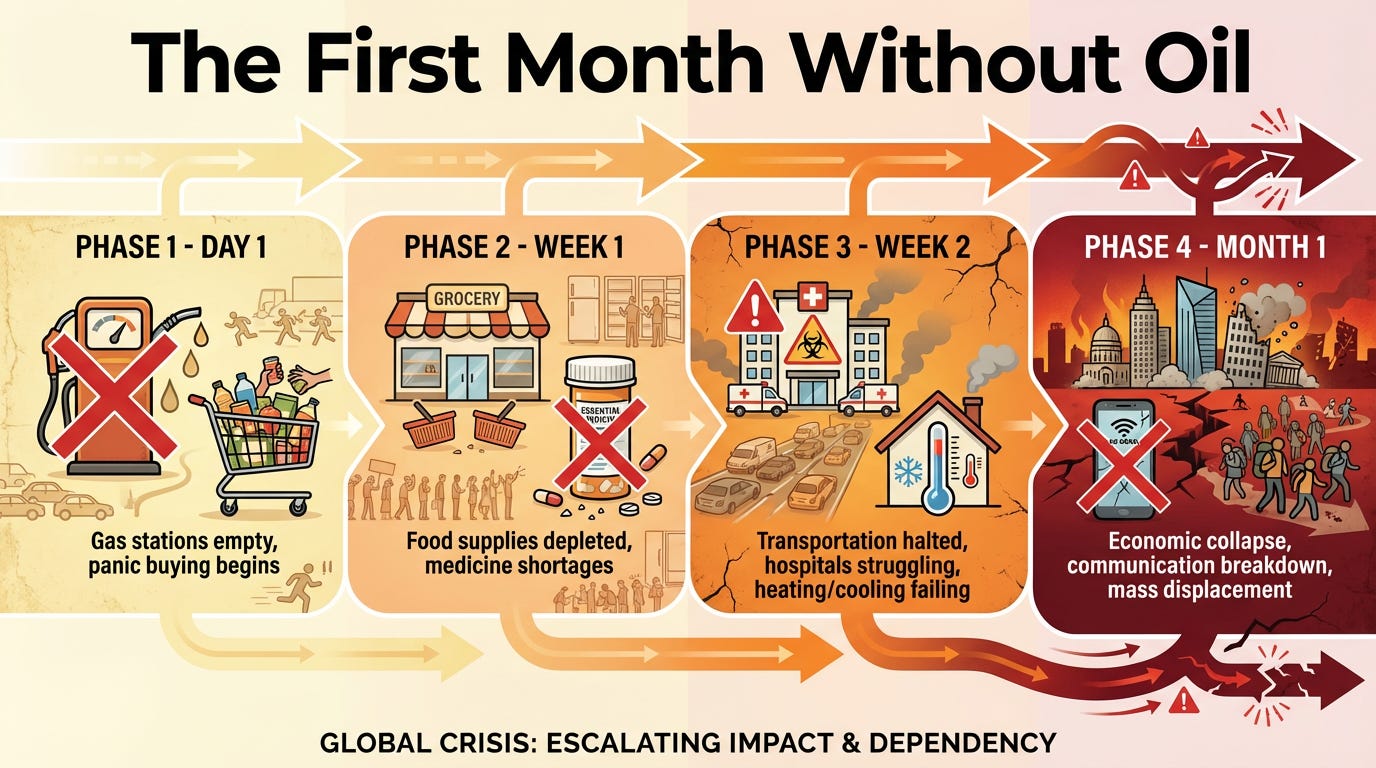
Without petroleum-based insulation and heating systems, homes in cold climates become hard to warm. Construction stops because modern building materials require petroleum products. PVC pipes, synthetic roofing, drywall. Communications get unreliable as the plastics in phones, computers, and network infrastructure can’t be replaced or repaired.
Your job probably doesn’t exist in its current form. Work from home? Your laptop and Wi-Fi equipment are petroleum-dependent. Commute? That option’s gone. Work in manufacturing, shipping, healthcare, education, or virtually any service industry? The supporting infrastructure crumbles.
For young professionals who built careers around remote work or digital services, the disruption hits particularly hard. That carefully assembled home office? The ergonomic chair, the monitors, the cable management system, the standing desk converter. All petroleum-based. The infrastructure of modern professional life vanishes.
Here’s the most sobering part. We can’t just “go back” to how things worked 150 years ago. Global population in 1870 was roughly 1.3 billion. Today it’s over 8 billion. Pre-petroleum agricultural methods, medical knowledge, and supply chains couldn’t support current population levels. The systemic collapse researchers describe isn’t hyperbole. It’s arithmetic.
This isn’t about romanticising the past or catastrophizing the present. It’s about understanding the actual scope of petroleum integration into modern life.
The Point Isn’t Fear
If you’re feeling overwhelmed, that’s understandable. But it’s not the goal.
The purpose of this thought experiment isn’t to generate policy anxiety or make you feel helpless about modern complexity. It’s to reveal something most people never consider. How interwoven petroleum has become with virtually every aspect of daily life. Especially the parts we don’t think about.
For sustainability-minded young professionals, this creates a paradox. Many want to reduce environmental footprint, support renewables, make values-aligned choices. Worthy goals. But understanding petroleum’s current role in everything from the plant-based protein in your smoothie (petroleum-based fertilizers and transport) to the solar panels on your roof (manufacturing requires petrochemicals) helps you grasp the genuine complexity of energy transition.
This isn’t about defending fossil fuel dependence forever. It’s about recognizing that meaningful change requires acknowledging current reality. You can’t transition away from something until you honestly understand what you’re transitioning away from.
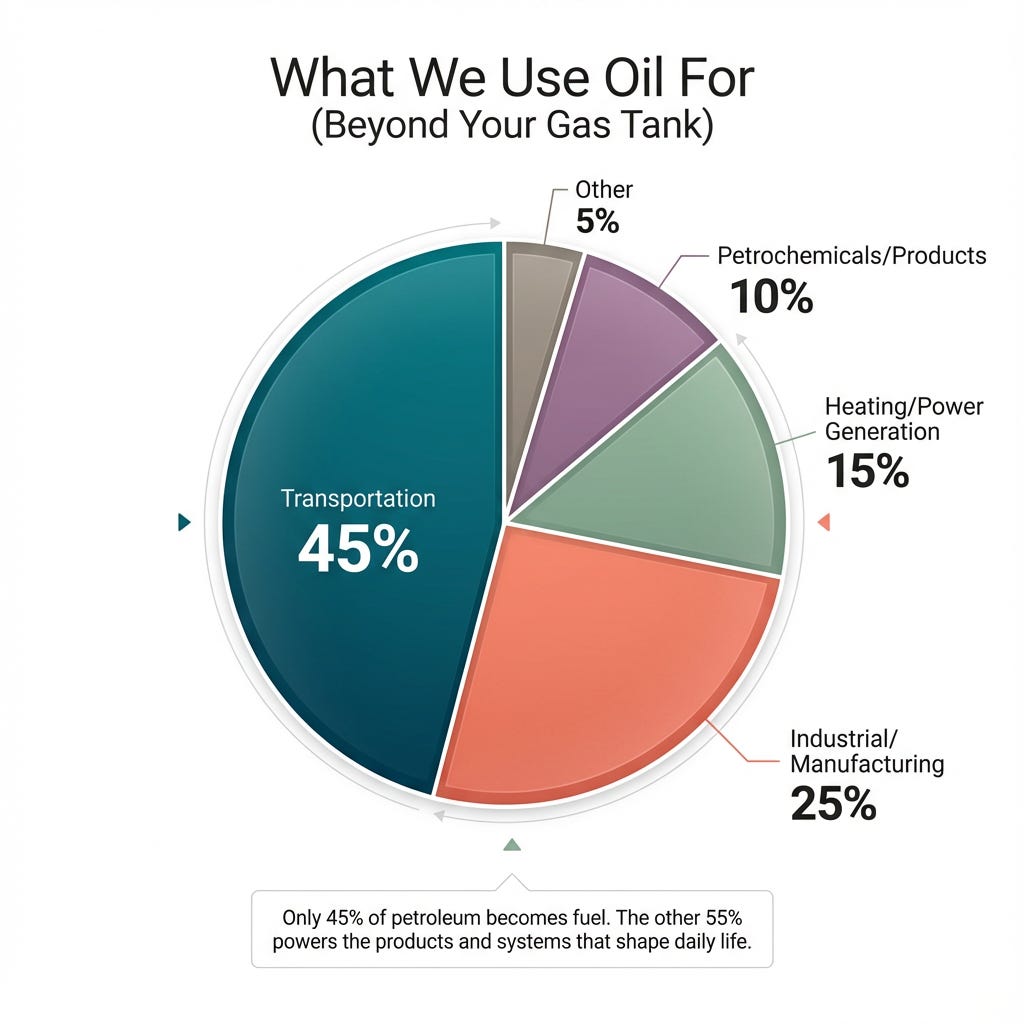
Only 45% of petroleum becomes fuel. The other 55% powers products and systems shaping daily life. Manufacturing. Heating. Petrochemicals in thousands of products. Even perfect EV adoption wouldn’t solve petroleum dependency.
For parents thinking about your kids’ future, this knowledge becomes a different tool. Yes, petroleum dependency creates environmental concerns worth addressing. But it also represents an extraordinary period of human innovation that delivered unprecedented comfort, health, and longevity. The challenge isn’t to reject that. It’s figuring out how to preserve the benefits while addressing sustainability concerns.
The answers won’t come from simplistic thinking on either side of the energy debate. They’ll come from people who understand the full scope of what petroleum currently does for us, and who can therefore think creatively about realistic alternatives and timelines.
Where We Go From Here
Next time you hear energy policy debates painting petroleum as simply “bad” or “good,” you’ll understand why reality is far more complicated. Petroleum isn’t just what goes in your car. It’s woven into modern life in ways that make immediate cessation not just difficult but genuinely catastrophic.
This knowledge changes how we think about energy transition timelines. Moving toward sustainable alternatives isn’t just about building enough solar panels or wind turbines to replace gasoline. It’s about developing alternatives for thousands of petroleum-based products that currently have no viable substitutes at scale. That’s a multi-generational project, not a policy decision happening in a single election cycle.
Most importantly, it helps us ask better questions. Not “how do we eliminate oil tomorrow?” but “how do we systematically reduce dependence while maintaining the genuine improvements in quality of life that petroleum-based products enabled?” That’s the conversation worth having.
The world uses over 100 million barrels per day, and that number keeps rising . Understanding why, really understanding the invisible dependencies we’ve created, is the first step toward making informed decisions about where we go from here.
If this changed how you think about energy, sustainability, or the hidden infrastructure of modern life, you’re exactly the kind of reader Flux Kinetics exists for. We dig into energy questions most people don’t even know to ask. We do it without the political posturing that usually dominates these conversations.
Each week, we explore one under-examined aspect of energy systems. Practical. Philosophical. If you enjoyed this, subscribe so you don’t miss the next one. Our next piece examines something equally invisible: the electricity grid’s hidden vulnerabilities and what they mean for your daily life. Join a growing community of people who want to understand the energy systems that quietly shape everything.
If you found this eye-opening, share it with someone who’d appreciate this perspective. Your sustainability-focused colleague. The parent in your life concerned about future impacts. That friend who’s always asking the “why” questions about how things work.
Because the more people who understand these connections, the better conversations we can have about what comes next.
Flux Kinetics - Where energy meets intelligence,
Wassim C.
This content is for educational purposes only and does not constitute financial, legal, or tax advice. All opinions and analyses are my own, and any actions you take are at your own risk after consulting an appropriate professional.
How about gas?
How about Gas ?