

The Crack Broke First
Nobody was watching the unit that makes diesel...

Dear Executives, Traders, Investors, and Friends
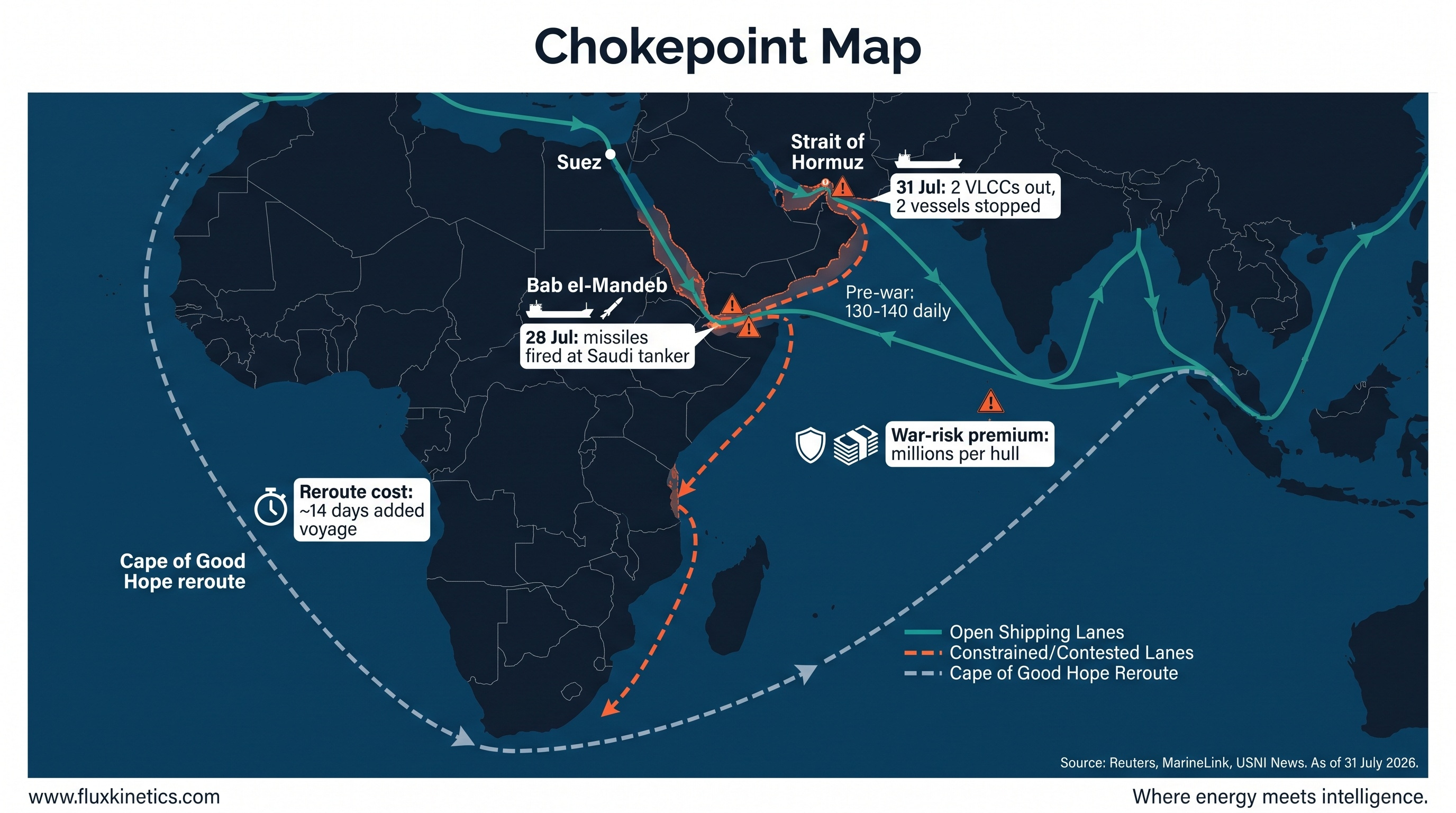
On Friday two very large crude carriers cleared the Strait of Hormuz, and Iran stopped two more vessels trying to leave. Brent settled at $90.12, up 1.2% on the day, down 6.9% on the week from $96.78 the previous Friday. Transits remain a fraction of the 130 to 140 vessels a day that crossed before the war. The tape decided that was enough.
European diesel cracks hit $93.44 a barrel this week, a record. Crude fell nearly 7% over the same stretch. Those two prints in the same five days are the entire story.
The scarcity moved downstream. The market kept pricing upstream.
Trump weekend habit, “Weekend Gambits” as per Bloomberg, is back… brace for today’s week start.
This Week’s Settle
Brief Contents
The crack, not the barrel
Salt caverns quietly drawing
Copper holds, lithium bleeds
The reserve that isn’t
Week Ahead: What to Watch
The crack, not the barrel
Diesel cracks in Europe topped $90 a barrel on 29 July and printed a record $93.44 by 30 July. US refiners responded the only way they can: operations hit 97.2%, up 1.1 points on the week, with crude runs adding 271 thousand barrels a day.
That pulled 7.2 million barrels out of commercial crude inventories, down to 404.5 million, with Cushing at 18.6 million. Refiners running flat out is not a demand signal for crude. It is a distress signal from the product barrel.
What needs our focus is a refinery at 97.2% has no upside left. There is no second shift, no spare column, no switch to flip.
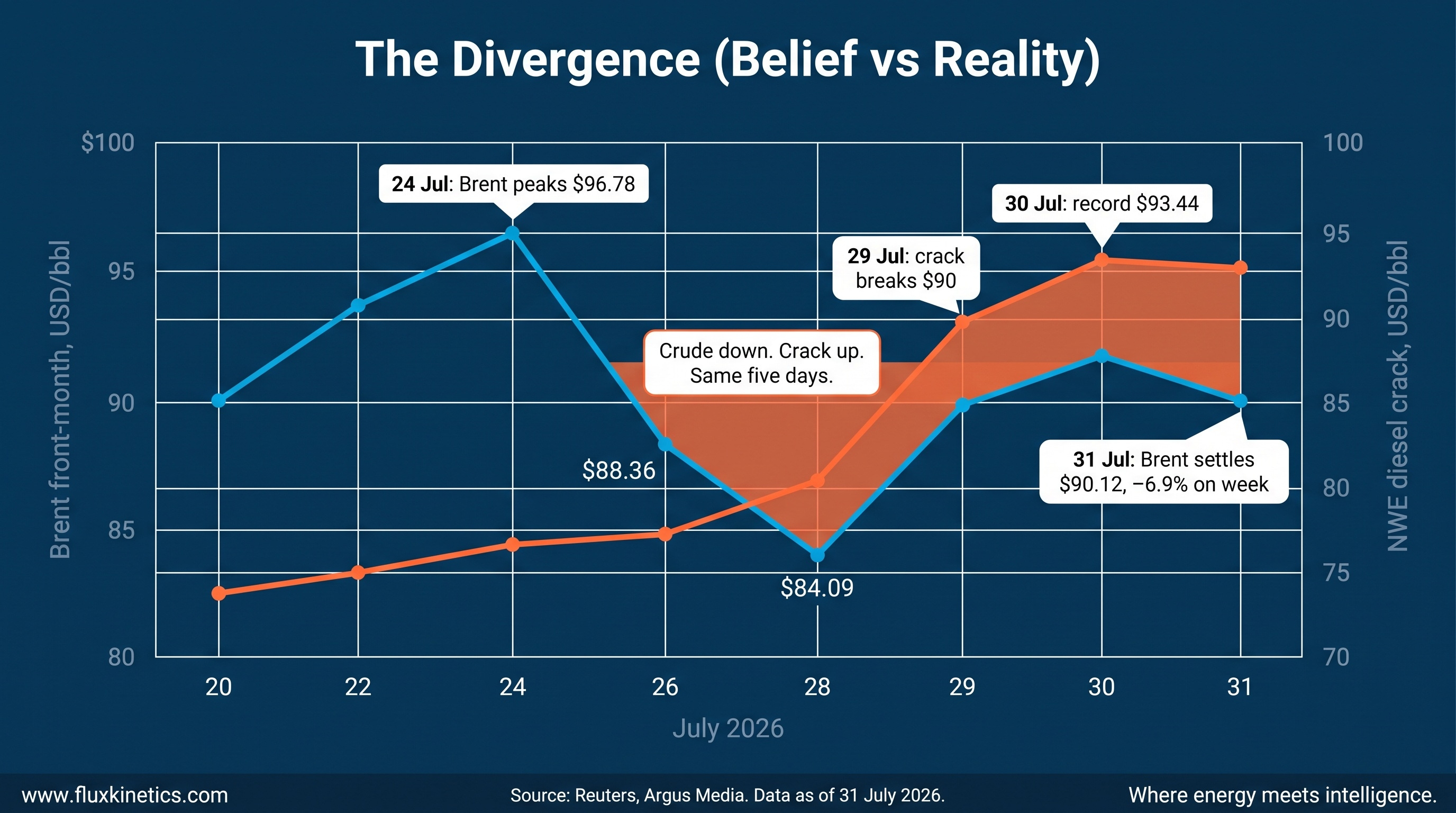
Now look at the numbers. Crude fell 6.9% on the week while the crack made an all-time high. That gap is not sentiment. Paper crude reprices in seconds on a headline about talks… as this weekend with Trump mentioning a halt of attacks and start of discussions.
Distillation capacity reprices over four to six years, which is what it takes to permit, finance, and commission a complex unit. The market can un price a war before lunch… It cannot un price a missing hydro cracker.
THE NUMBER: 97.2%. Usage at that level with cracks at a record means the shortage is physical, not positional. Every incremental barrel OPEC+ adds now meets a refining system with no headroom to convert it.
Crude trades the ceasefire. Diesel trades the distillation column. Only one of those can be rebuilt with a headline.
Salt caverns quietly drawing
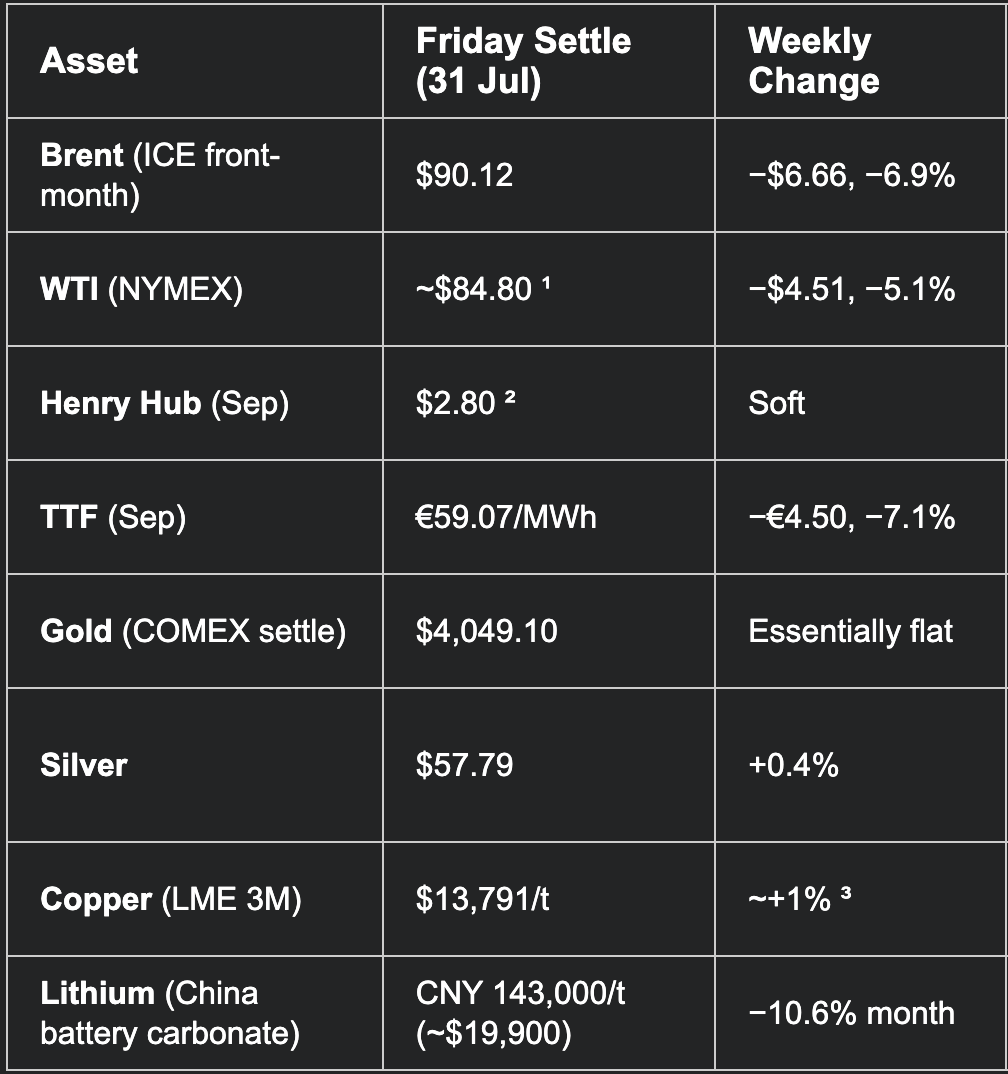
Lower 48 working gas rose 28 Bcf to 3,084 Bcf for the week ending 24 July, 185 Bcf above the five-year average and 32 Bcf below last year.
The headline reads loose again while the regional split does not…
The driver most coverage missed this week is underneath that national number. South Central withdrew 9 Bcf, and the salt caverns inside it drew 14 Bcf, during injection season. Salt is the fast-cycling storage that sits next to Gulf Coast liquefaction and gas fired power. When salt draws in late July, feedgas and power burn are winning the molecule against the refill.
Henry Hub still sits near $2.80 because the national cushion is real. TTF at €59.07 is roughly seven times that on an energy-equivalent basis, and it fell 7.1% on the week on the same peace bid that hit crude.
The front of the US curve is priced off storage and the back is priced off a Gulf Coast that is already short in the fast tank.
THE FLUX KINETICS INSIDER VIEW: Equity markets capitalised the US LNG buildout years ago. The physical market only started feeling the basis consequence this summer, one salt-cavern withdrawal at a time.
Copper holds, lithium bleeds
Gold settled $4,049.10 on COMEX Friday, essentially unchanged on the week. Read that against a week where Brent swung more than $12 and Iran was stopping tankers in Hormuz. Gold did not bid the escalation…
That is the cleanest positioning read available:
When the classic hedge stays flat through a genuine chokepoint scare, the marginal buyer already believes in de-escalation.
The Sunday OPEC+ decision and Monday’s slide only confirmed what the metal had priced on Wednesday.
Copper held at $13,791 a tonne on LME 3M, roughly 1% firmer on a cash-to-3M basis. Lithium went the other way, printing CNY 143,000 a tonne on 31 July.
Copper is a grid and transformer story with a physical order-book behind it.
THE FLUX KINETICS TRADE: Previous Long Gold position is still valid while 4,000$ hold. We are currently in short term range.
Intraday traders can play the channel between 4,000$ and 4,150$ with tight stops.
The Reserve that isn’t
The US Strategic Petroleum Reserve fell 3.7 million barrels last week to roughly 308 million, the lowest since March 1983, after 352 million barrels of withdrawals in four years (Department of Energy data). When the 172-million-barrel release ordered in March is fully executed, the reserve lands near 243 million.
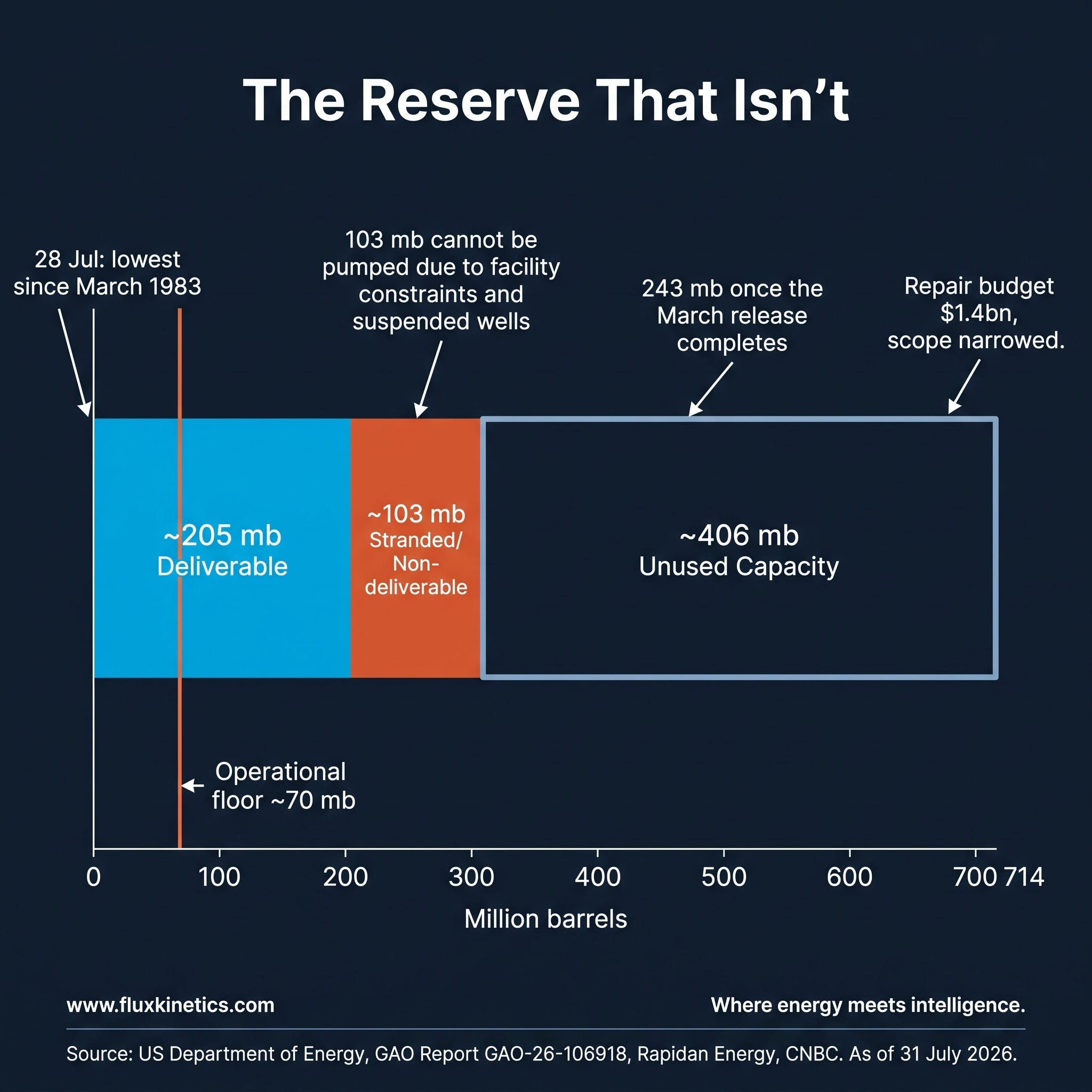
The number that matters is not the headline balance. The Government Accountability Office found more than a quarter of the SPR unavailable for drawdown because of construction and cavern outages.
DOE officials told auditors the pipeline and cavern network is held together with “Band-Aids.” The $1.4 billion repair programme had its scope narrowed to stay inside budget.
Strip out what cannot be pumped and the deliverable reserve is closer to 205 million barrels against a stated operational floor near 70 million.
The country spent its shock absorber and has not booked the rebuild.
The SPR is not a reserve anymore. It is a balance sheet entry with a maintenance backlog attached.
THE POLICY PULSE: Refill demand is now a structural bid sitting somewhere in 2027 to 2030. On current trajectory that is 60 to 100 million barrels of state purchasing that no forward curve currently carries.
Chokepoints and Capital Flows
Three constraints defined this week, and none of them can be engineered away inside a year.
Hormuz is the obvious one. Two VLCCs exited Friday against a pre-war baseline of 130 to 140 vessels daily, with Iran stopping two more.
The Red Sea is the second, with Houthi action at a Saudi tanker on 28 July, pushing war-risk premiums into the millions per hull and forcing Cape reroutes that add roughly two weeks of voyage time…
The third is the one with the longest lead time and the least coverage. Global refining capacity is the binding constraint, and a new complex conversion unit takes four to six years from FID to first product.
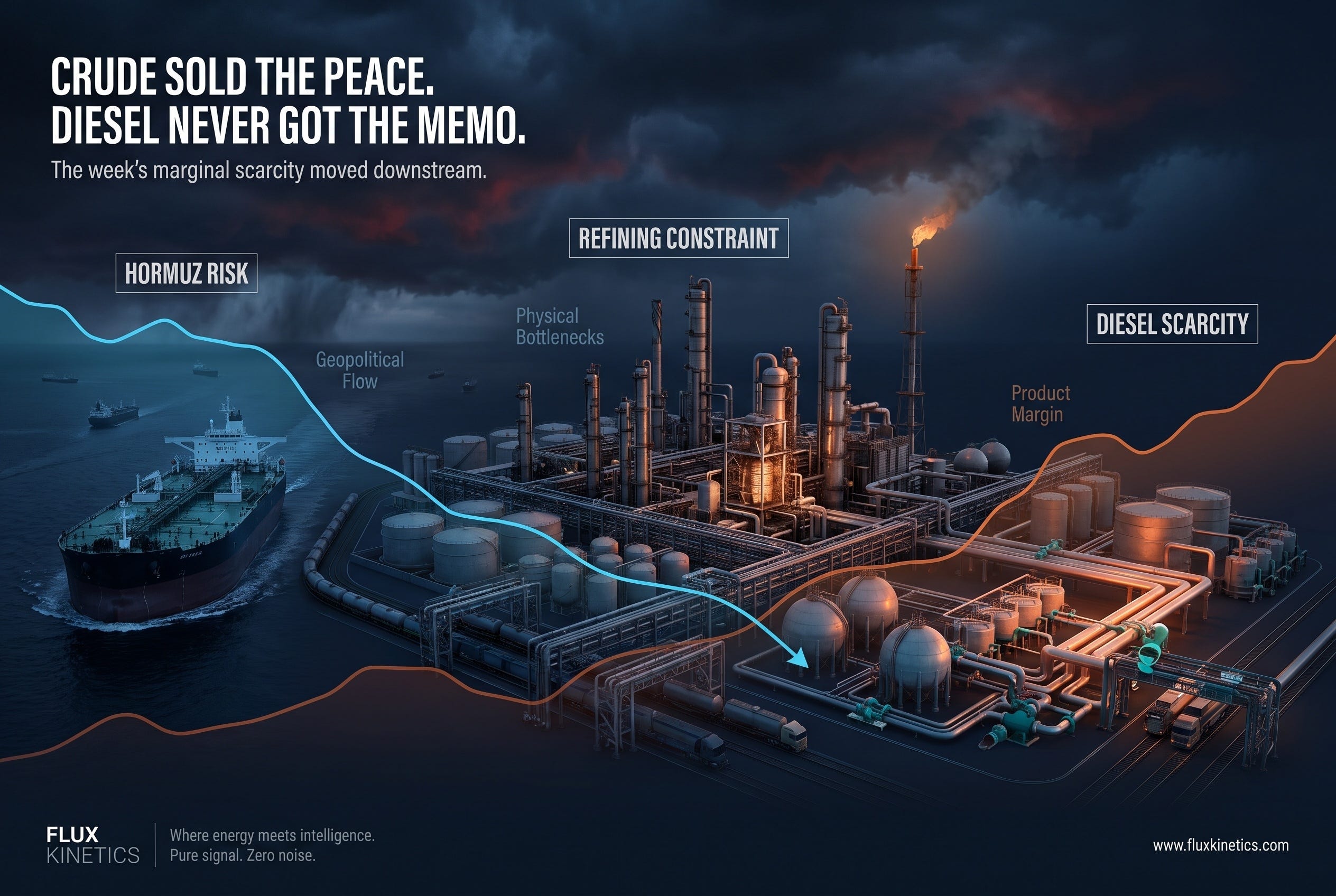
The paper market is selling crude because peace talks resumed and OPEC+ completed its rollback of the 2023 voluntary cuts with a September increase of about 188,000 barrels a day. The physical market is paying a record for diesel because the kit that makes it is either offline or maxed out. Don’t confuse the weather with the cycle.
Barrels are not scarce. The equipment that turns them into diesel is.
Week Ahead: What to Watch
EIA Weekly Petroleum Status Report, Wednesday 5 August.
EIA Natural Gas Storage, Thursday 6 August.
Baker Hughes rig count, Friday 7 August.
CFTC Commitments of Traders, Friday 7 August.
The market spent the week pricing whether the war premium would retreat.
The better question was whether the diesel system could rebuild its margin of safety.
Coming next:
Russia’s Diesel Didn’t Vanish…
⚡ One last thing
If this changed how you see the week, send it to one person who needs to see it too. That is how Flux Kinetics grows. Reader by reader, not algorithm by algorithm.
📨 Share • 📬 Subscribe • 💬 Leave a comment
Flux Kinetics - Where Energy Meets Intelligence.
Wassim CHIADLI
This content is for educational purposes only and does not constitute financial, legal, or tax advice. All opinions and analyses are my own, and any actions you take are at your own risk after consulting an appropriate professional.
Good to see you are back !
I love this perspective. Too often we focus on the moment everything fails, when the real story is the small crack that appeared long before anyone paid attention. As a product developer, I’ve learned that success and failure are both built one tiny decision at a time. Outstanding insight.