

Iran, Oil and Your Wallet
One tense week in Iran just raised the price of your future energy.

What actually happened this week
Over the last 7 days, the US and Iran moved from angry words to visible military pressure, and oil markets reacted fast.
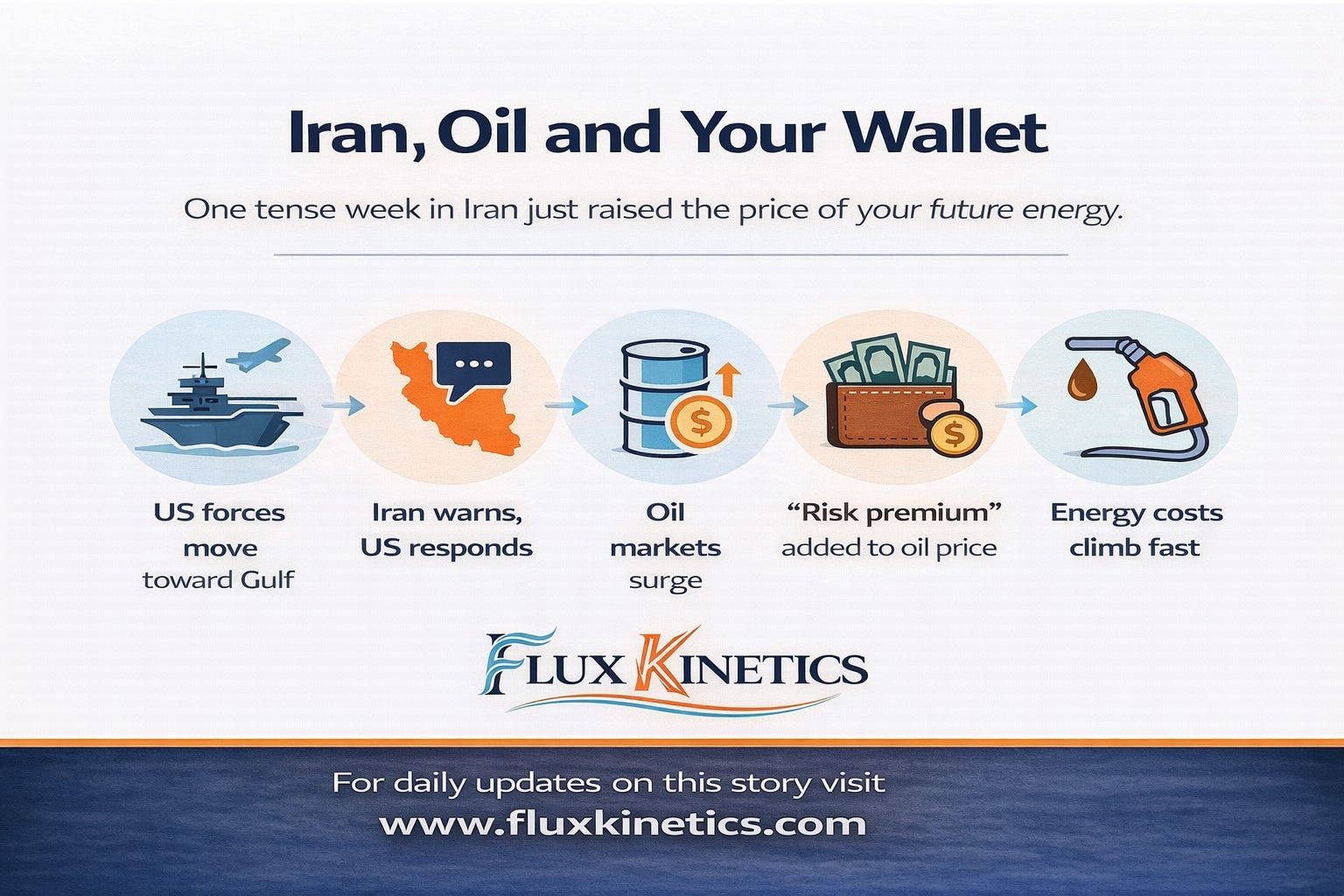
President Trump said a “massive armada” is heading toward the Gulf region with Iran as its main focus. US officials confirmed that an aircraft carrier strike group and extra air force assets are moving into position, adding thousands of troops and strong strike capability near Iran. This comes on top of weeks of protests and a harsh crackdown inside Iran.
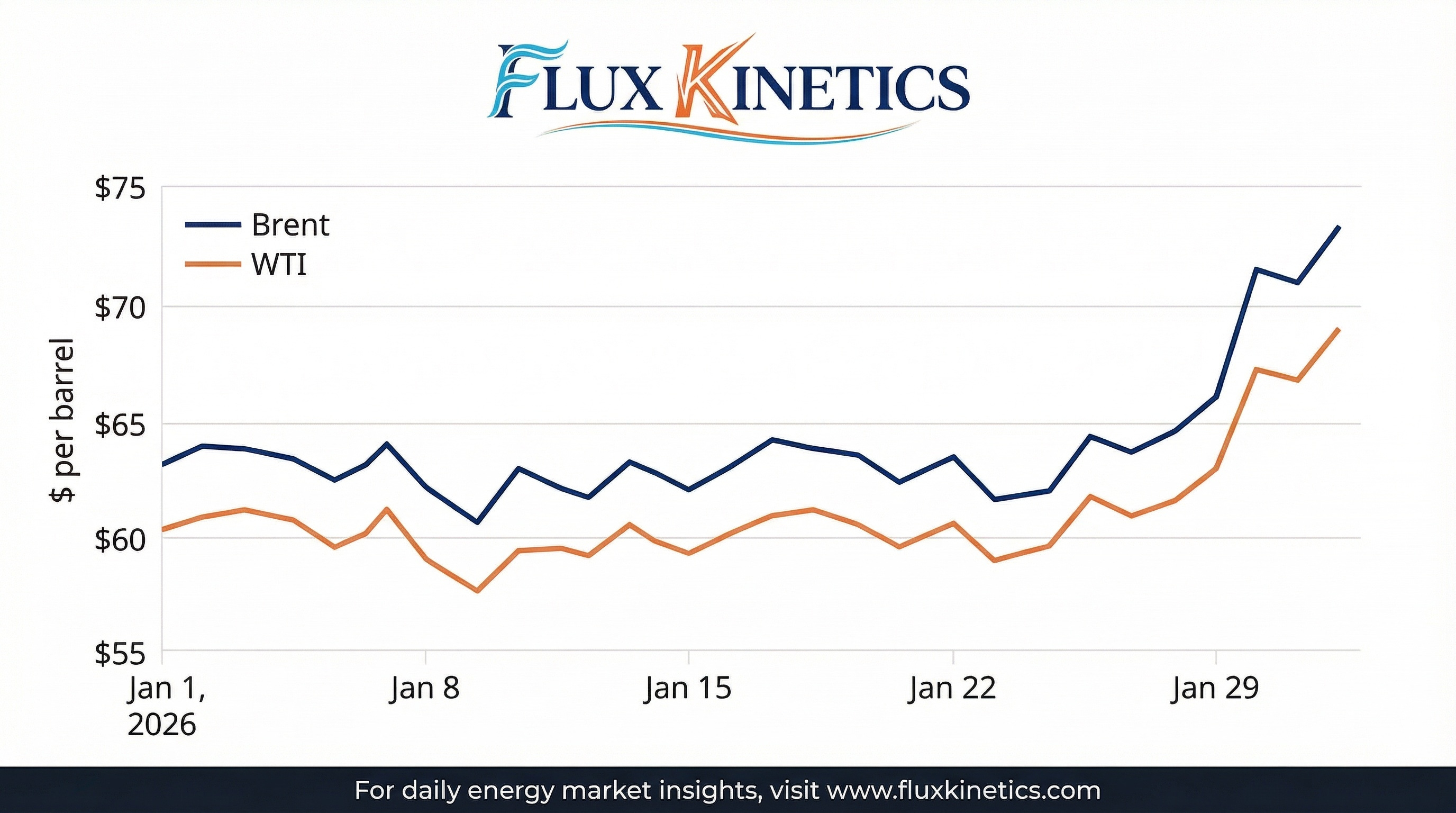
Oil traders immediately priced in the risk that a confrontation could put part of Middle East supply at risk. Brent and WTI have risen for several days in a row. By Jan 28 to 29, Brent was around $68 to over $70 per barrel and WTI around $63 to $64, the highest in about 4 months. Since Jan 26, the 2 benchmarks are up roughly 5 % on growing fears of a possible US strike on Iran and a disruptive response from Tehran.
There is a clear “risk premium” is sitting in the price. Some estimates put this at $3 to $4 per barrel, while others see as much as $7 to $10 of extra geopolitical premium if the crisis drags on. The key driver in all of this is not only Iran’s own oil, but the narrow waterway next to it.
Around ⅕ of the world’s oil and a similar share of liquefied natural gas move every day through the Strait of Hormuz, a narrow sea lane between Iran and Oman that links Gulf exporters with global markets. When tension rises around Iran, traders think not only about Iranian exports, but also about any risk to all the tankers and LNG ships that must pass this chokepoint.
How this can hit supply, prices and daily life
Right now, flows are still moving. There has been no attack on tankers, no closure of Hormuz, and no confirmed US strike on Iran this week. The risk is mainly about what could happen if the situation steps up 1 more level.
Energy agencies and banks point to 3 broad paths. In the first, and still most likely, the US keeps up pressure through military presence and sanctions, while Iran sticks to threats and drills but does not block shipping. Oil keeps trading with a risk premium, maybe a few dollars above where it would sit with calm headlines.
In the second path, there are some limited incidents. This could mean harassment of tankers, drone shots near ships, or temporary pauses in loading at some Gulf ports. Even if damage is small and short, freight rates and insurance costs jump, and refiners and utilities scramble for cargoes. In such a case, prices can spike sharply for days or weeks, with moves of $10 or more not unusual based on past crises, before easing when escorts and workarounds appear.
The worst case is a real attempt to close or severely disrupt the Strait of Hormuz. Nearly 20 % of global oil supply and large volumes of LNG would be at risk, and only a fraction of this can be rerouted through pipelines that avoid the strait. Analysts agree this is still a low probability move because it would hurt Iran’s own exports and likely bring a rapid military response. But it is the scenario that pushes crude well above $90 or even $100 and turns this from a market story into a global economic shock.
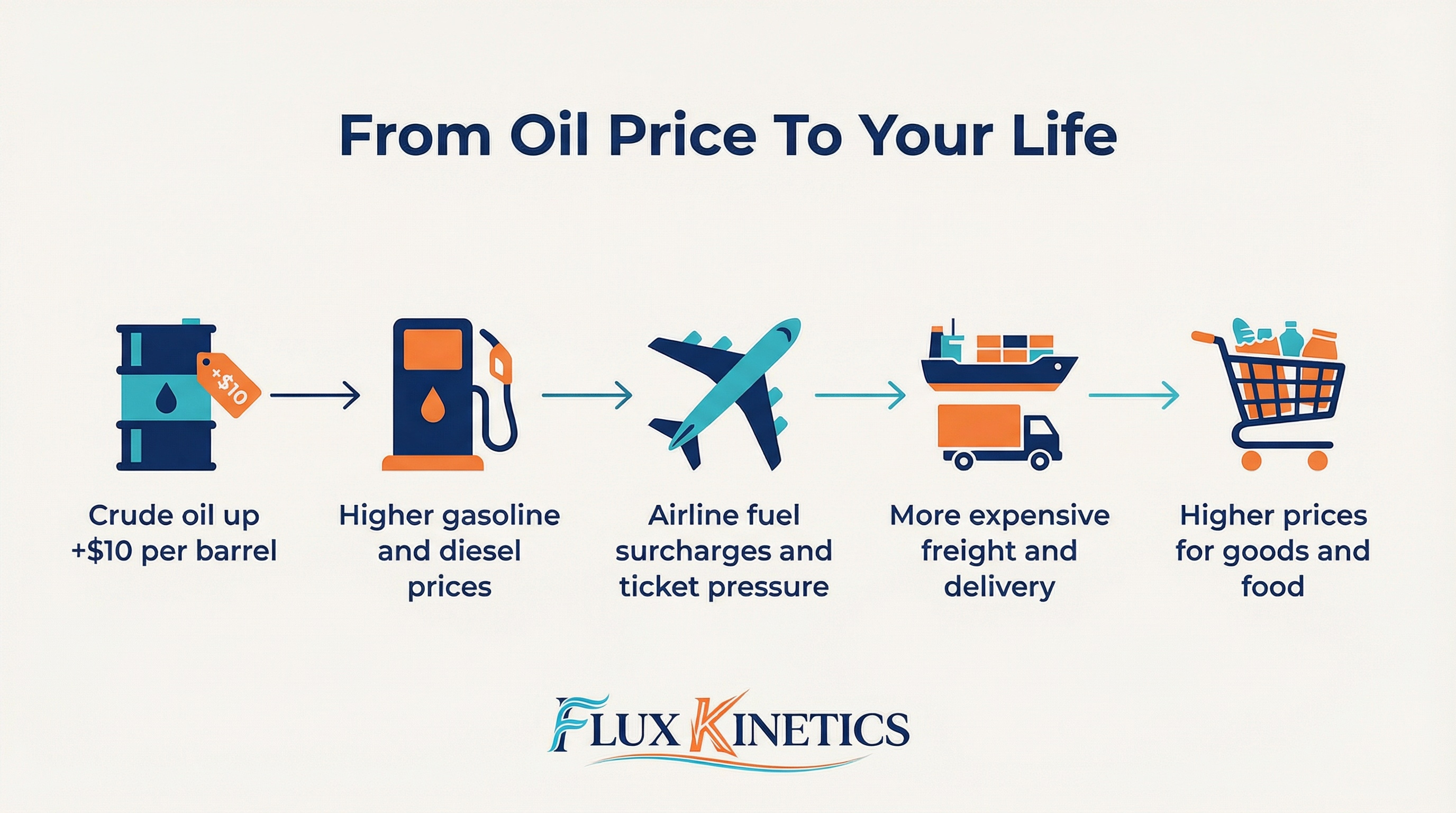
Even if you live far from the Gulf, this can touch your life. Oil is priced globally. A higher Brent price feeds into the cost of road fuel, jet fuel, shipping, and often into gas and power prices too. Airlines may add fuel surcharges, delivery companies may raise fees, and food and goods that travel long distances get a little more expensive. Governments with fuel subsidies may face budget pressure, and countries that rely heavily on imported energy, especially in Asia, feel the squeeze in their trade balances.
If you are a household, this might show up first at the pump or on a utility bill. If you are a business, it might hit your cost base or freight charges. Even if you never look at a barrel number, your monthly bills do.
Signals for investors and energy pros
For the next 0 to 3 months, the main driver is headlines and risk management, not new oil fields. Stocks of oil are still reasonable. Other producers, especially in the Gulf and in the US, have some ability to raise output if prices stay higher for a while. This does not stop sharp spikes, but it limits how long those spikes can last if supply is not physically hit.
Traders have started to pay more for protection against big upside moves. Options markets show higher demand for call options and for structures that gain if prices jump suddenly in the near term. This tells us that many in the market see a clear chance of a sharp short burst higher if a strike or shipping incident happens in the next few weeks.
Looking 3 to 12 months out, the picture is more about layers of risk. Iran is now 1 of several pressure points, along with past issues in places like Venezuela and the Red Sea. OPEC+ still controls most spare capacity. US shale growth is slower and more disciplined than in past cycles. Put together, this means the downside for oil might be limited unless global demand weakens a lot.
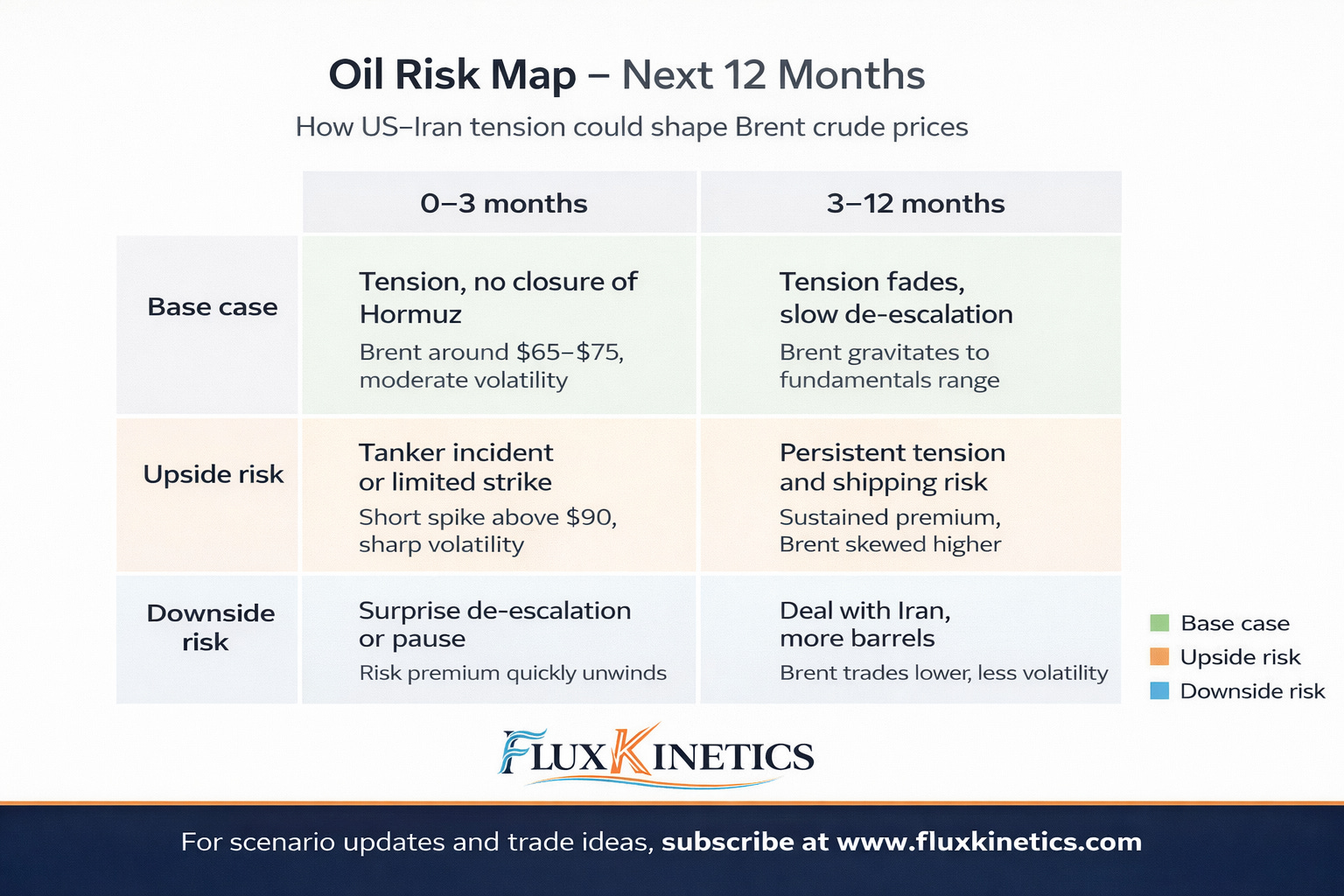
If tension slowly cools, a future US Iran deal could remove part of the risk premium. Citi, for example, says a deal later this year could cut $7 to $10 per barrel of geopolitical premium. If instead the armada stays on station and Iran pushes back, that premium can become a semi‑permanent feature of pricing, especially for nearby months.
For policymakers and company risk teams, this week is a reminder that energy security is not just about how much oil a country uses, but where it comes from and how it moves. Heavy reliance on 1 chokepoint means a protest in Tehran or a tweet from Washington can end up affecting a factory or a bus fleet thousands of kilometers away
Iran Energy Playbook, Professional Edition
This is the part where we turn scary headlines into a clear, practical playbook. If you are a pro, treat it as a structured checklist. If you are new, treat it as a simple set of moves you can actually follow.
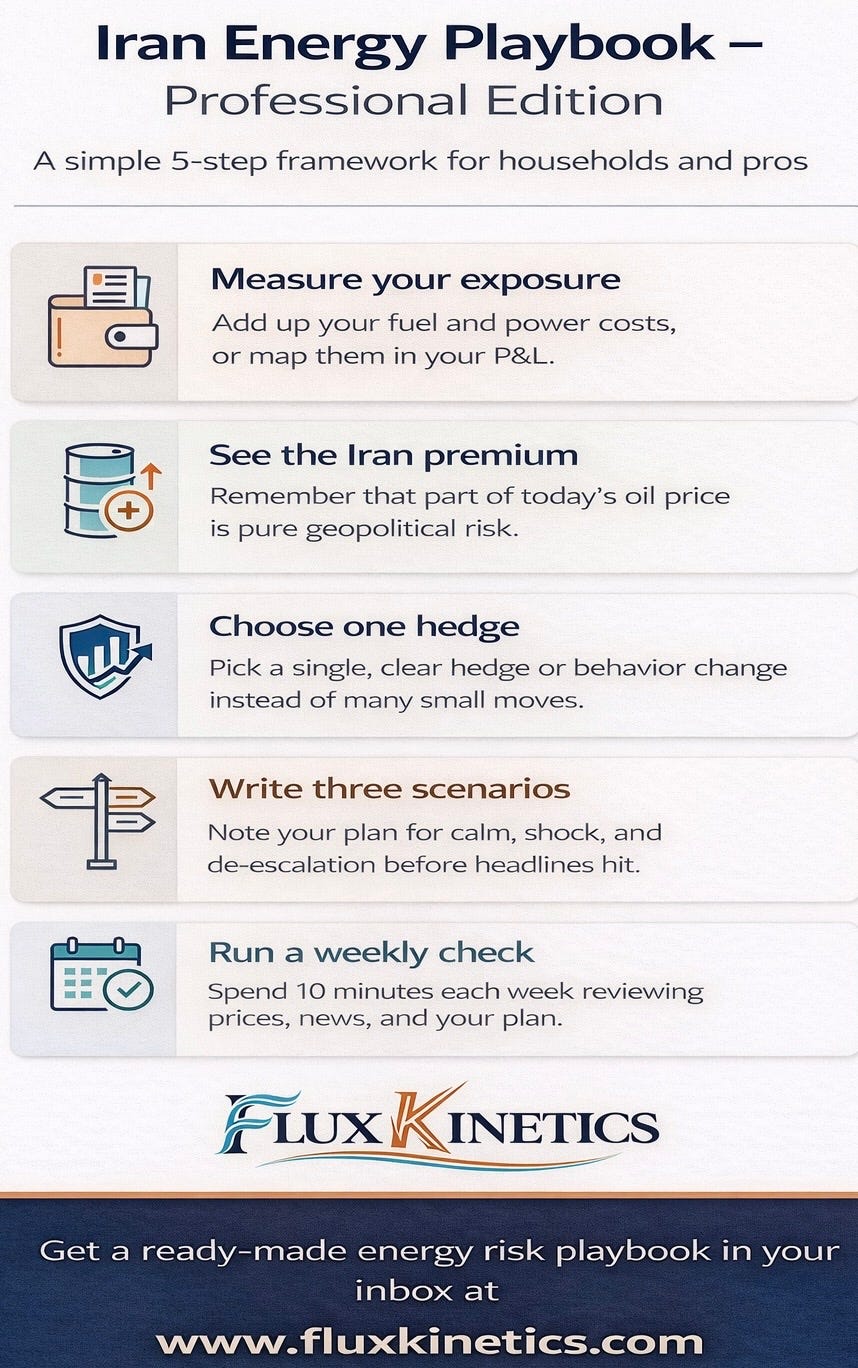
1. Measure your real energy exposure
Beginner version. Grab your last 1 or 2 months of fuel and power bills. Add them up. That number is your personal “oil exposure.”
Pro version. Map your direct and indirect energy costs in your P&L or budget. Fuel, freight, power contracts, key inputs that track hydrocarbons. Now you know how a 5–10 % move in energy can hit you.
2. Isolate the “Iran premium” in your mind and in your model
There is now a clear risk premium in oil, roughly $3–$4 per barrel in the mild view and up to $7–$10 in the more cautious view.
Beginner move. Remember that part of what you pay at the pump is that extra layer of tension, not just “companies raising prices.”
Pro move. Split today’s Brent into “base” and “Iran premium” in your model. Treat the premium as a separate risk that can be hedged with options or spreads instead of large outright directional bets.
3. Choose one clear hedge or behavior change, not ten
Beginner move. Pick 1 easy action that lowers your fuel or power use while prices are jumpy. Combine errands, use public transport 1 day a week, or nudge your thermostat by 1 degree toward outside. It is simple, but it matters when prices spike.
Pro move. Choose 1 straightforward instrument that benefits if oil jumps. That could be a modest position in an energy ETF, a basic call option on oil, or a direct fuel hedge for your business. Size it so that a nasty headline hurts less because your hedge pays out when it happens.
4. Write three short scenarios and link them to actions
On 1 page, write 3 headings. Calm tension. Short sharp shock. De‑escalation.
Under each, add a quick view on oil direction and 1 or 2 actions. For example, “short shock: oil pops above $90, I hold or take profit on upside hedges and delay fuel‑heavy projects.”
Beginners keep it to simple budget and behavior changes.
Pros can add rough probabilities, target exposures and risk limits.
5. Build a disciplined 10‑minute monitoring routine
Once a week, pick a fixed time. Check 3 things. Current oil price, 1 trusted energy news source, and the latest Flux Kinetics note. No doom scroll, no chasing every rumor. Just a focused check on whether your 3 scenarios need updating and whether your positions or habits need a small adjustment.
Why this matters to you and why this community exists
It is easy to see US Iran tension as something far away. But as we have seen this week, a single phrase like “massive armada” and a few ship movements can raise the price of the fuel in your car, the ticket for your next flight, and the power that keeps your home and data centers running.
Flux Kinetics exists to make that link clear and practical. We bring together traders, energy workers, policy people and curious readers who all share 1 thing. You do not want to be surprised by the next big move in energy and commodities.
If you want ongoing, plain language briefings that turn complex events like the Iran crisis into clear risks and opportunities, you are exactly who this newsletter is for.
You probably know at least 1 person who will be hit harder by higher energy costs or who trades these moves without a clear map. Send this to them. It might help them protect their budget, their book or their business the next time a headline hits.
Flux Kinetics - Where energy meets intelligence,
Wassim C.

This content is for educational purposes only and does not constitute financial, legal, or tax advice. All opinions and analyses are my own, and any actions you take are at your own risk after consulting an appropriate professional.
Good to see your feedback in Iran situation and the impact in oil market !