

Faster Than F1 Cars at 320 KM/H
But They Look So Slow...

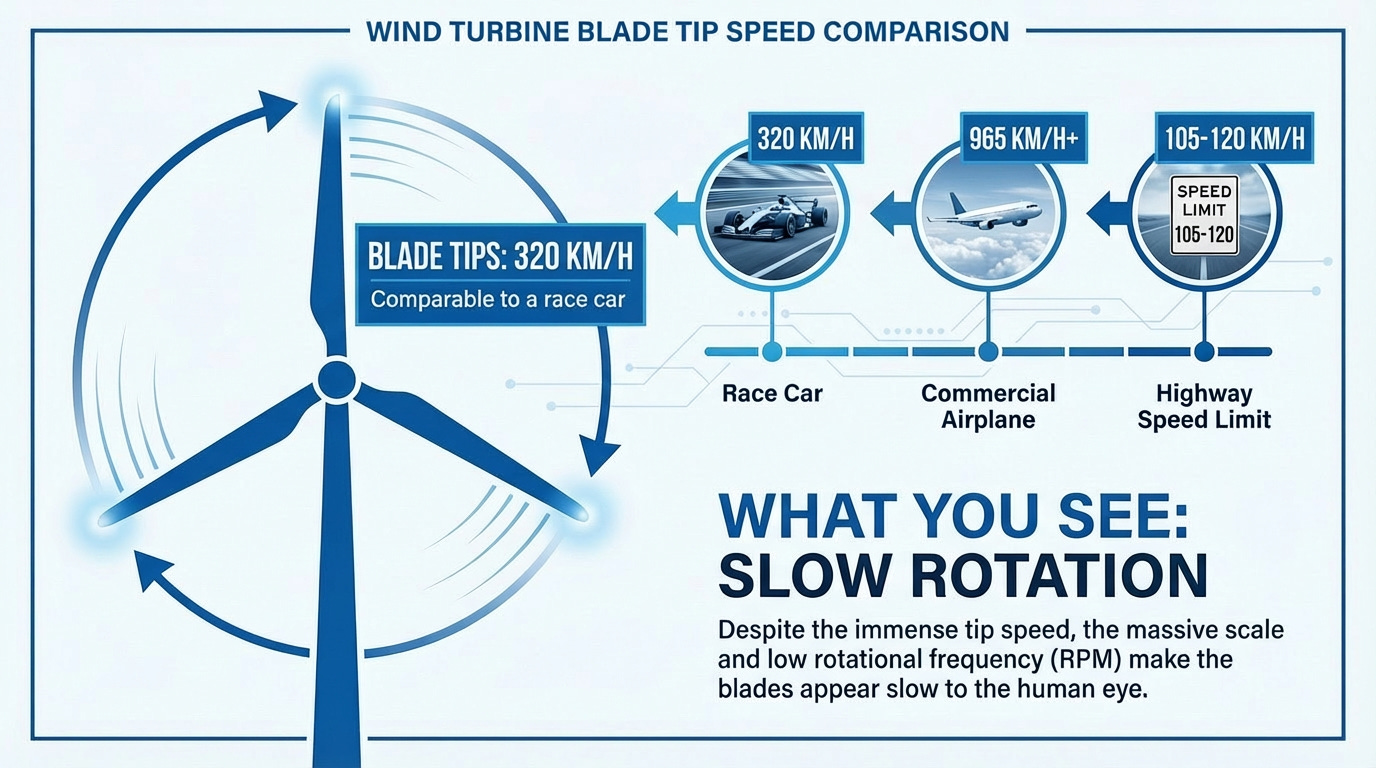
Here’s something wild: the tips of wind turbine blades spin faster than a race car zooming down the highway. We’re talking about 320 kilometers per hour! Yet when you watch them from the ground, they look like they’re barely moving at a lazy pace. That’s because these machines are absolutely massive. Each blade can be as long as half a football field, and the towers stand taller than the Statue of Liberty. When something that huge spins, even slow rotations mean the tips are whipping through the air at incredible speeds.
So how does all that spinning actually turn into the electricity that powers your home, charges your phone, and keeps your refrigerator running?
Think of a wind turbine like a bicycle in reverse. When you pedal a bike, your legs create motion that turns the wheels and moves you forward. A wind turbine works backward: wind pushes against the blades, which are shaped like giant airplane wings, and that push makes them spin. Those spinning blades are connected to a thick rod running down through the tower. As the blades turn, the rod spins too (kind of like how turning a doorknob makes the metal piece inside the door rotate).
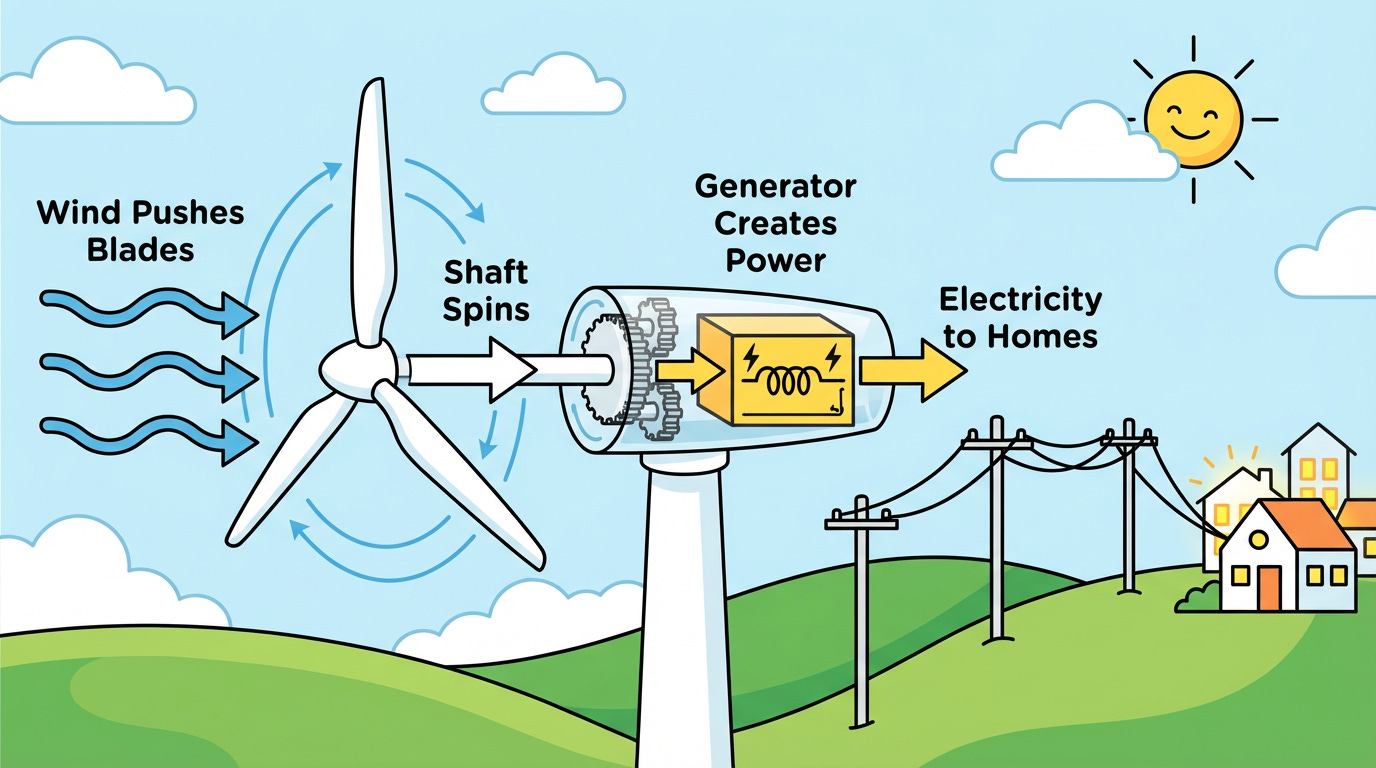
That spinning rod connects to the real magic maker: a machine called a generator. You might have used a hand-crank flashlight before, the kind where you squeeze a handle over and over to make a light bulb glow. A wind turbine generator works on the exact same idea, just much more powerful and spinning constantly instead of in short bursts.
Inside the generator lives the secret to making electricity. Picture a merry-go-round at a playground, but instead of horses, there are huge magnets attached to it. Around this spinning carousel of magnets, thick copper wire is coiled up like springs (thousands and thousands of loops). When the rod from the blades spins the magnets, something invisible but powerful happens
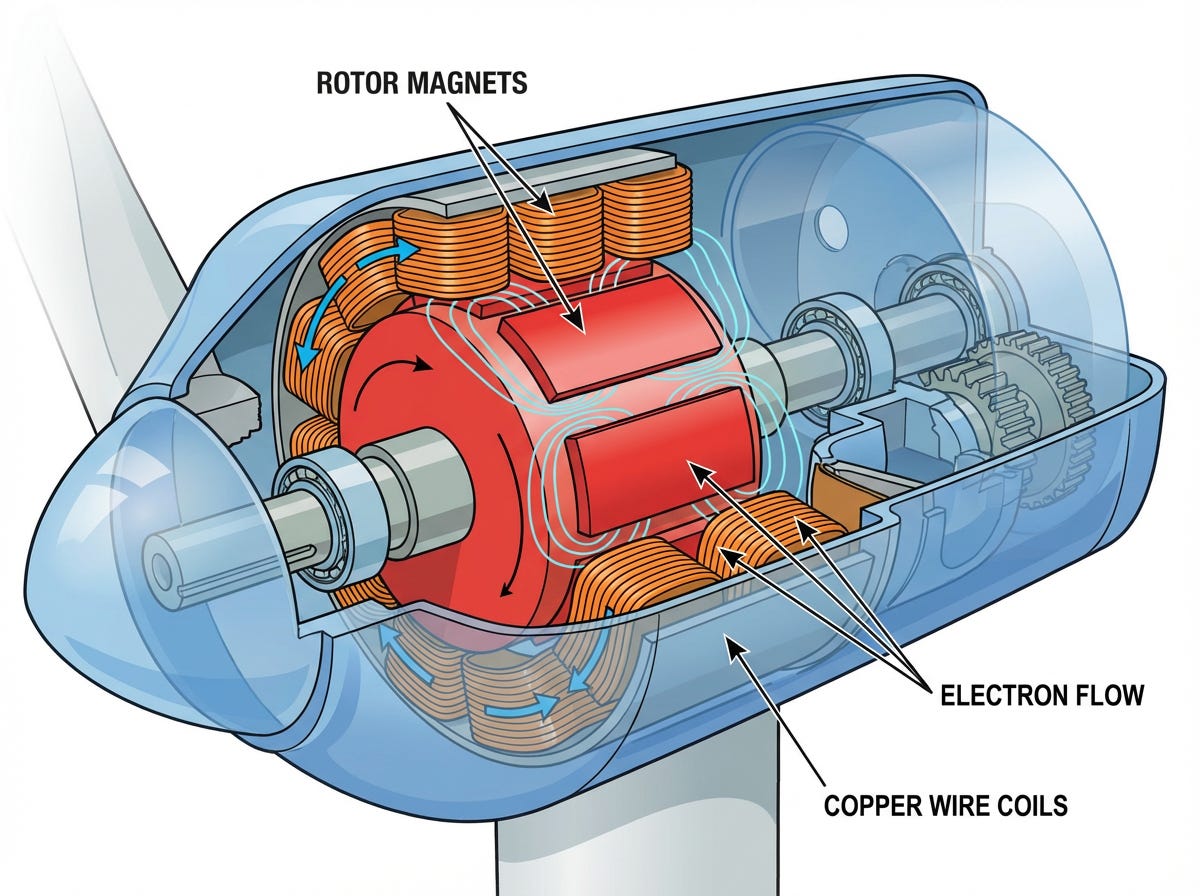
Magnets create an invisible force field around them. You’ve felt this if you’ve ever pushed two magnets together and felt them either stick or push apart. When magnets spin past copper wire, that invisible force gives a tiny push to particles inside the wire called electrons. Electrons are impossibly small (millions of them would fit on the period at the end of this sentence), but when billions of them start flowing together through the wire, that’s electricity.
It’s like a river. One water drop isn’t impressive, but millions flowing together can power a waterwheel or carve through rock. Electrons flowing through wire can power everything from a light bulb to your entire house.
The faster the blades spin, the faster the magnets whirl, and the more electrons get pushed along. That’s why wind turbines work best on windy days. But here’s another surprise: they start making electricity when the wind is only blowing 10 to 15 kilometers per hour (about the speed of a gentle jog). You don’t need a hurricane; you just need a decent breeze.
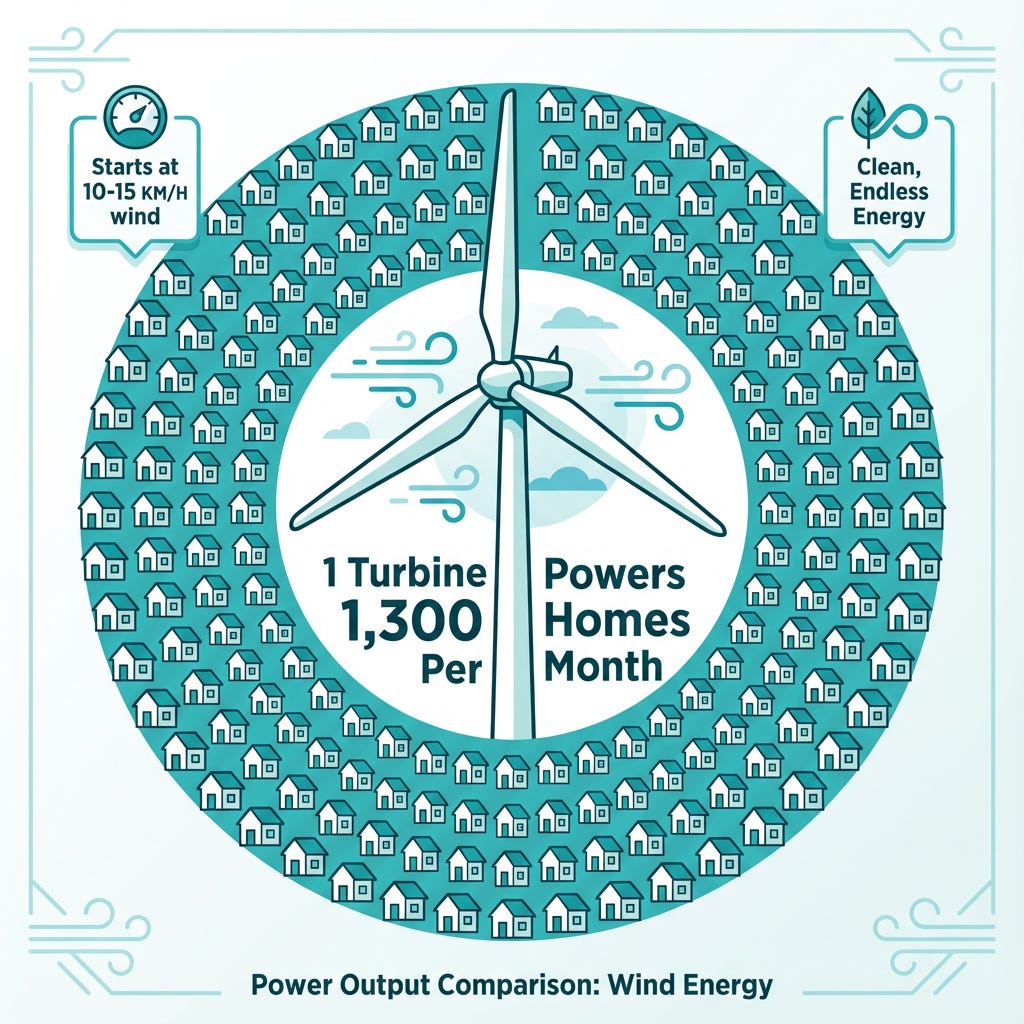
One big turbine spinning for a month can create enough electricity to power over 1,300 homes. That’s an entire neighborhood powered by wind. And unlike coal or gas that eventually runs out, wind is free and endless. Rain or shine, day or night, as long as air moves across the earth (which it always will), these gentle giants keep making clean energy.
The next time you see a wind turbine standing against the sky, remember: those blades that look like they’re barely moving are actually racing at highway speeds, turning an invisible force into the power that lights up your world.
If this insight surprised you, share it with someone who'd love to learn how these massive machines actually work.
Fluxkinetics Newsletter delivers these insights weekly. Markets do not wait for quarterly reports. Join the professionals who read us first and subscribe Now.
Flux Kinetics - Where energy meets intelligence,
Wassim C.

This content is for educational purposes only and does not constitute financial, legal, or tax advice. All opinions and analyses are my own, and any actions you take are at your own risk after consulting an appropriate professional.
Thank you for explaining in an easy and simple way this Energy concept which sometimes can be complexe